Mobile Applications / Buyer’s guide
A Paused Rollout Does Not Take the Update Back
A phased app update needs more than a pause button. Separate distribution, feature switches, backend compatibility and data repair before you release.
The short answer
Specify four separate controls: app distribution, feature exposure, backend compatibility and data repair. Halting a store rollout does not uninstall copies already delivered. Agree what each control changes, which users remain exposed, who may act and what evidence supports the next decision. Prepare a corrective release for cases a remote switch cannot contain.
Discuss your project ↗
Our take
A rollout plan is useful when it explains what stays live after someone presses pause.
In this article
01 / 06
The release is paused. The new app is still on the phone.
A booking app gets a new appointment picker. The team releases the update gradually. Then customers start reaching the last step without receiving a confirmed slot. Someone pauses the rollout and says, ‘We have rolled it back.’
But a customer who installed the update ten minutes earlier opens it again. Which appointment picker do they get? Which API does it call? Can their next attempt create a second reservation?
This is an invented commissioning scenario, not a client incident. It exposes the gap between stopping more installations and containing the behaviour of installations you already have. For a mobile app update, those are different delivery responsibilities.
This guide begins after the decision that a candidate is fit to release. The release acceptance guide covers that earlier evidence. Here, the question is how exposure grows—and what the business can actually do when the evidence changes.
02 / 06
A store pause is a distribution control, not a recall
Google Play’s staged-rollout guidance is explicit: halting prevents additional users from receiving that version; people who already received it remain on it. Staged rollouts apply to updates, not the first publication of an app. Their percentage does not increase automatically.
Apple’s phased release spreads automatic updates, but people can still download the update manually. That is not the same as a closed pilot where only named participants can access a new experience.
There is another useful distinction: Google also documents halting a fully rolled-out release under its stated conditions, making a previous version available to eligible users who have not installed the halted one. That does not mean every installed copy is downgraded. Check the current track, previous eligible version and platform rules rather than relying on the word ‘rollback’.
Our recommendation is to write the containment statement in user terms: ‘No further eligible recipients through this rollout; installed users continue on version X.’ Then describe what protects those remaining users. The second sentence is often where the missing engineering work becomes visible.
03 / 06
Four controls sit behind one reassuring word
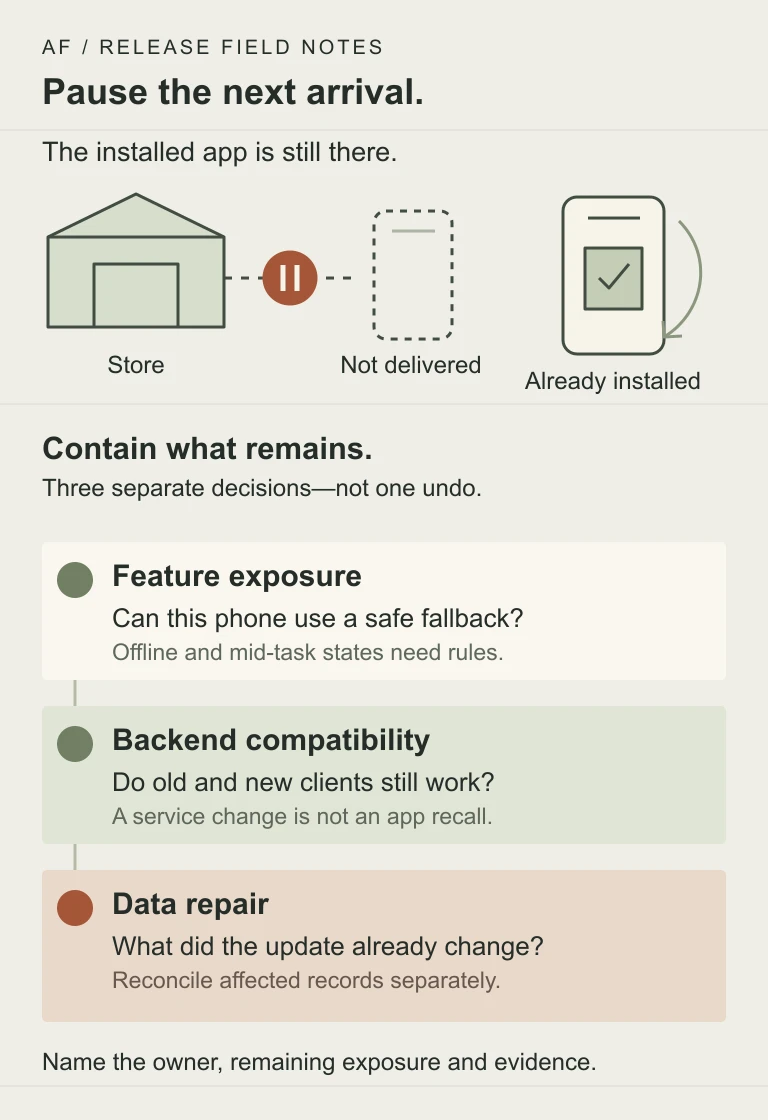
A remote feature switch can be valuable if the installed build already contains a safe alternative. It cannot invent an old screen or repair a broken startup path that prevents the app from reaching configuration.
Nor does changing a remote value mean every phone has applied it. Firebase’s loading strategies distinguish fetching from activating configuration and discuss when the app should use new values. They also recommend in-app defaults rather than depending on a network connection. A customer who is offline, or mid-task, needs an explicit outcome.
The backend is a third control. A compatible service can support old and new clients while the app update is repaired. But switching the service back is unsafe if the newly installed app requires a response the old service no longer supplies. Compatibility needs to be designed before rollout, not assumed during an incident.
The fourth control is data correction. Turning off the new picker does not cancel a reservation it already saved. Restoring a whole database could also remove legitimate work completed meanwhile. The recovery agreement is a separate discipline; for this release, name which records may need reconciliation and who can approve it.
04 / 06
Ask what changes—and what remains exposed
Use this Axiom Forge scope matrix to remove ambiguity from a supplier’s rollout proposal. It is a decision aid, not a claim that every app needs the same architecture.
| Control | What it can contain | What still needs a decision |
|---|---|---|
| Pause distribution | Further delivery through the applicable store rollout mechanism. | Already installed versions remain. Name their safe operating path and the corrective build. |
| Disable a feature | New use of a feature where the installed app can apply the switch and use a safe fallback. | Offline clients, activation timing and tasks already in progress. |
| Restore compatible service behaviour | Faulty backend behaviour, where a safe compatible service or configuration is available. | Old and new clients must still work; changed records and queued requests do not disappear. |
| Reconcile affected records | Specific inconsistent or duplicated business outcomes after investigation. | Authority, evidence, customer communication and preservation of unrelated legitimate work. |
A proposal that says ‘feature flags included’ should explain which journeys they cover. A switch around the new picker may help the example above; it may do nothing for a login crash or an incompatible local database migration. If an issue requires a new binary, store processing and user adoption are dependencies—not a recovery time the supplier can promise to control completely.
05 / 06
A quiet dashboard is not permission to expand
Choose the first exposure group for a reason: the journey it exercises, the supported devices and versions, the operating team that can help, and the maximum consequence the business is willing to accept. A small percentage is not automatically a representative group, and no percentage makes an unsafe write safe.
For the booking example, inspect attempts that reach slot selection, confirmed reservations in the receiving system, unresolved outcomes and repeated submissions. Slice the observations by relevant app and backend versions. Crash-free sessions alone cannot tell you that a customer actually secured an appointment.
Agree a baseline and a minimum useful observation before expanding. A cohort with no relevant completed journeys has not demonstrated success. If the sample is too small to support a rate comparison, say so and hold the decision rather than manufacturing confidence from a green chart.
Our recommendation is to separate three states. Go means the agreed evidence supports the next exposure step. Hold means evidence is incomplete or an unexplained change needs investigation. Stop and contain means a defined material failure requires action. Name the decision-maker and deputy, and make critical customer-impact signals capable of stopping expansion even if an aggregate metric looks healthy.
06 / 06
The useful record fits the incident you might actually have
For the illustrative update, a useful release record would read like this:
- Exposure: the named app build, compatible API/configuration versions, distribution channel and feature eligibility rule are recorded separately.
- Decision: an operations owner reviews confirmed booking outcomes before each expansion; a deputy can hold or stop it when the owner is unavailable.
- Containment: pause further store distribution and disable the new picker where the installed client can activate the safe fallback. State what an offline or mid-booking customer sees.
- Recovery: keep compatible service behaviour for supported app versions, identify ambiguous reservations before retrying, and prepare a corrected app build if client behaviour cannot be contained remotely.
- Closure: reconcile affected reservations, communicate with affected customers through an approved route, and verify the corrected journey before resuming.
This is an example of decisions to make, not an approved plan for your system. Attach the actual owners, signals, thresholds, coverage gaps and evidence. Rehearse the agreed controls with synthetic records in an appropriate environment; do not discover that the pause owner lacks access during the real event.
Put ongoing observation and incident coverage into the maintenance agreement. A release plan that depends on someone watching overnight is incomplete if nobody has accepted that responsibility.
If you are commissioning an app update, Axiom Forge can discuss rollout boundaries alongside the product and integration scope. Send the changed journey, supported app versions and existing systems through the project brief or hello@axiomforge.am. Leave out credentials and private customer records. A scoped discussion is not a guarantee of instant rollback or incident-free operation.
Sources and editorial scope
This is Axiom Forge’s procurement and product-delivery guidance, not a guaranteed project plan. The example is illustrative. Sources checked on 22 Oct 2026.
- Google Play — Release app updates with staged rollouts — Update-only staging, percentage changes and the installed-user boundary after a halt.
- Apple — Release a version update in phases — Automatic-update phasing and manual-download availability.
- Firebase — Remote Config loading strategies — Fetching, activation, timing and in-app defaults; configuration is not a universal instant recall.
- Google Play — Halt a fully rolled-out release — Conditions and recipient limits of halting a fully distributed release.