Mobile Apps / Buyer’s guide
Offline-First Mobile Apps: What to Scope Before You Build
Plan an app that remains useful without signal. Define offline tasks, data freshness, sync conflicts and what counts as a completed business action.
The short answer
Choose the tasks that must work without a connection—not an ‘offline mode’ for everything. Specify which information is available locally, which changes survive an interruption, how freshness is shown and when the server must approve an action. Agree conflict rules, retry behaviour, device-data protection and a visible route for unresolved work. A local save is not proof of delivery, and background synchronisation is not a guaranteed instant service.
Discuss your project ↗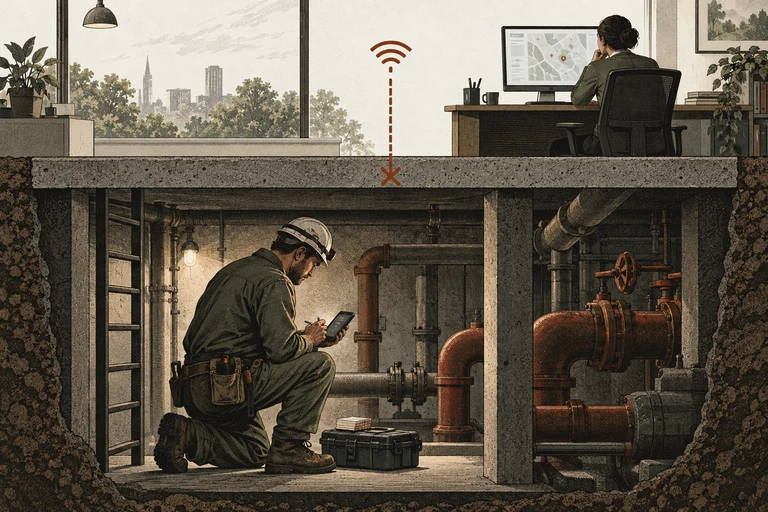
Our take
Offline capability is a promise about the work someone can safely continue. The important boundary is not whether the screen opens; it is what the business can honestly call saved, received or complete.
In this article
01 / 08
The visit is finished. Has the office received it?
Imagine a technician finishing a visit in a basement with no mobile signal. They add a note and tap save. The phone displays a reassuring tick. Upstairs, the dispatcher still sees the job as open. Both people are looking at different parts of the same unfinished journey.
This is a hypothetical example, not an Axiom Forge client incident. It explains a purchasing question that ‘the app should work offline’ leaves unanswered: does the tick mean the note is on this device, received by the service, or accepted as a completed job?
An app can remain useful without promising all three at once. Reading a prepared job pack, keeping a draft and committing a scarce booking are different operations. They deserve different rules, even when they appear on neighbouring screens.
Start by finding the interruption that matters. Is someone briefly passing through a tunnel, working for a shift without dependable reception, or preparing on Wi-Fi before leaving? Specify the actual task and conditions. You are buying continuity for that work, not a label in a feature list.
02 / 08
Buy the smallest offline promise that solves the problem
Axiom Forge recommends deciding offline scope task by task. If a read-only reference pack meets the need, there may be no reason to commission two-way editing. If the worker must capture an observation, losing that draft on restart is a different failure from receiving it later at the office.
Android’s offline-first guidance distinguishes reading local data from different write strategies. Offline reading does not require every write to work offline. That distinction is useful when comparing proposals; it is not a promise that one Android implementation automatically covers iOS.
| Task | Useful promise | Additional work to scope |
|---|---|---|
| Read prepared information | Open the agreed local pack and see its freshness. | Download boundary, missing data and expiry behaviour. |
| Capture a draft | Retain input on this device across an agreed restart. | Durable storage, attachments, edit and discard rules. |
| Send captured work | Show pending delivery until a verified response. | Retry safety, authentication and a recovery route. |
| Edit a shared record | Explain changes made elsewhere before applying an update. | Versions, conflict policy and review ownership. |
| Make a live commitment | Require server approval when the business rule needs it. | Online-only boundary or a separately designed reservation model. |
This is a buying framework, not a standard feature package. A locally captured booking request need not be a confirmed reservation. If you need commitments without live coordination, that is a separate domain-design problem—not a free consequence of adding a database to the phone.
03 / 08
What must already be on the device when the connection disappears?
A screen cannot reliably show material it never received. List the records, instructions, images and related documents required for the chosen task. Decide when they are downloaded and how the person knows preparation is complete. A first launch without a connection is a different case from returning to previously prepared work.
Define freshness in business terms. A visitor guide may remain useful after a delay; a changed assignment or current stock level may not. Show when information was last refreshed and what the user may do with it. Avoid presenting a cached value as a live promise.
Keep the pack proportionate. Downloading the entire organisation’s dataset can add exposure, storage and update work without helping a particular visit. Ask the team to justify the local subset, attachment sizes and removal policy against the real workflow.
Include a failed preparation path. If a required document is absent, the app should distinguish ‘not downloaded’ from ‘there is no document’. Decide whether the task can continue, needs a connection or requires operational support. Those choices belong in the brief before a screen design hides the distinction.
04 / 08
Give ‘saved’ and ‘accepted’ different meanings
For the visit note, a local save protects the worker’s input within the agreed device conditions. It does not tell the dispatcher anything yet. A delivery attempt adds another state, and a server response can either accept the update or explain why it needs attention.
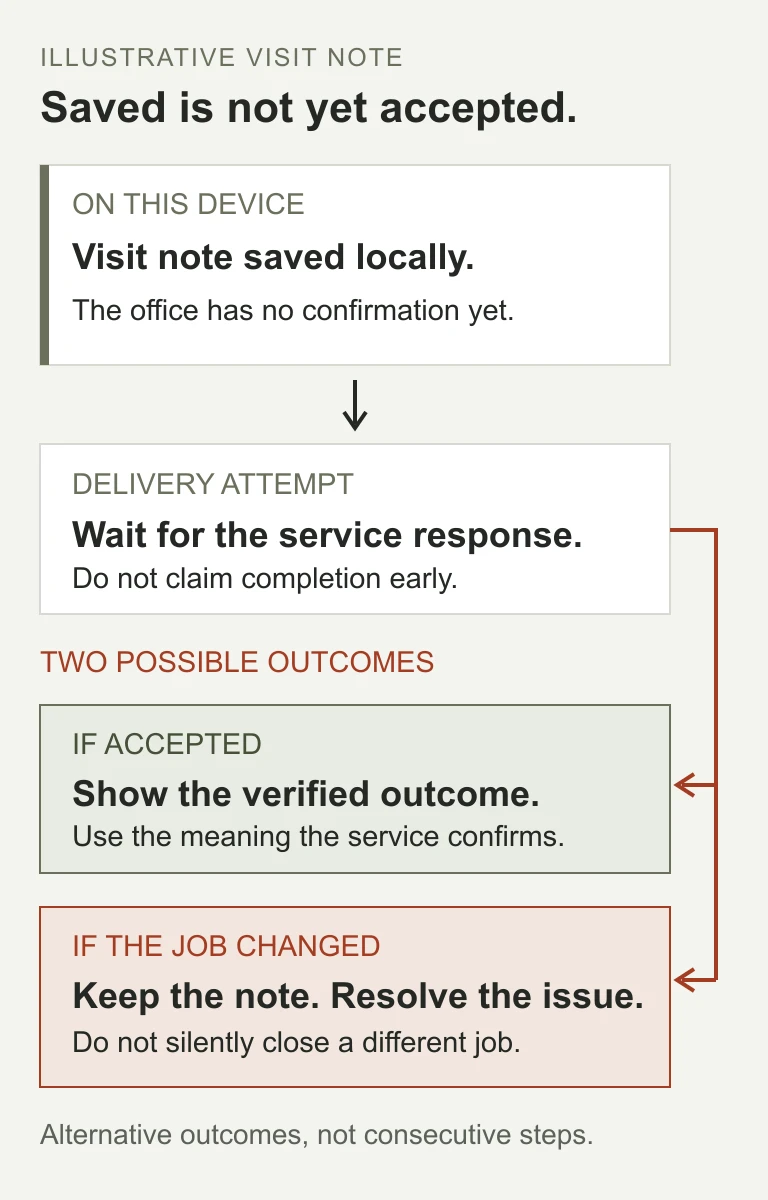
Use words people can act on: ‘Saved on this device’, ‘Waiting to send’, ‘Received by the service’ or ‘Needs review’. Define the exact conditions behind those labels. A completed upload is not necessarily an approved business operation, especially if further processing follows.
Keep unresolved work discoverable. A pending-items view, a clear reason for failure and a safe next action are part of the experience—not a developer-only log. Decide who may edit or cancel an item and what happens if sending has already begun.
Do not promise protection against every device failure. Retaining a draft after an ordinary app restart is not the same as recovering it after a lost phone, deletion or storage damage. Name those boundaries plainly so the team and buyer do not assume a backup service that was never commissioned.
05 / 08
When the job changes, keep the observation without inventing authority
Return to the fictional basement visit. The technician starts from an assigned job and records an observation offline. Before the phone reconnects, the dispatcher changes the assignment. The arriving note is valuable, but it may no longer justify closing the current job.
One possible product rule is to preserve the observation, show the changed assignment and require an authorised operator to reconcile completion. Another could allow independent visit notes while treating job closure as online-only. These are design alternatives for discussion, not rules every field-work business should adopt.
Ask the buyer’s operational owner to settle the meaning before engineering chooses a conflict strategy. Which fields are independent additions? Which replace a shared value? Can someone’s correction be overwritten? What evidence must remain after a review? A later timestamp alone cannot answer those business questions.
Android’s guide discusses versioning and conflict-resolution choices. Axiom Forge’s recommendation is to commission the policy for your specific records rather than accept ‘the latest edit wins’ as an unexplained default. Preserve the difference between synchronising data and having permission to perform the action.
06 / 08
Reconnection is a chance to synchronise, not a stopwatch guarantee
Ask when work is attempted: while the app is open, when it is reopened, on an explicit send action and through the available background mechanisms. State what the user can see when a dependency remains unavailable. Do not turn ‘connection restored’ into an unsupported promise of immediate delivery.
Apple describes background execution as managed and opportunistic. Its earliestBeginDate documentation also makes clear that an earliest start is not a guaranteed launch time. On Android, WorkManager constraints can defer work, and work can stop when required conditions cease to hold.
The resulting buying decision is to scope a visible pending state and an appropriate foreground recovery route. A time-critical operational promise needs a system and process that can support it; it should not rest on a phone background scheduler alone.
Include interrupted attachments and uncertain responses in the design discussion. A photo may be retained locally while its upload is incomplete. A request may reach the service while the acknowledgement fails to return. Ask how the app recognises a retry of the same operation, avoids duplicated business effects and reconciles an uncertain result. Neither endless retry nor a connectivity icon proves completion.
07 / 08
Offline access moves part of the data boundary onto the phone
More local capability means deciding which information may remain on the device. OWASP MASVS-STORAGE-1 requires secure storage of sensitive data. It is a security requirement to evaluate, not a certification supplied by calling the app offline-first.
Ask the delivery team to define storage protection, logs and backup exposure, session rules, retention and account separation for the actual platform and risk. Include shared devices if they are part of the operating model. Local packs and pending attachments need the same deliberate review as the visible screens.
Permissions can change while a device is disconnected. A remote service cannot communicate a new revocation to an unreachable phone immediately. Decide whether offline access expires, which actions require online revalidation and what information is acceptable to retain under those limits.
Be explicit about logout and account changes. Silently deleting unsent work can lose an observation; keeping it accessible to the next account can expose it. Agree an authorised recovery or discard path and explain the consequence to the user. Legal retention and privacy duties depend on the actual data and markets and require appropriate specialist input.
08 / 08
Estimate the behaviour, then accept it with evidence
Before asking for a price, provide the critical tasks, connection conditions, data pack, backend interfaces, attachment types and people who may change the same records. Mark the actions that need live authority. A proposal should separate preparation, local persistence, synchronisation, conflict handling, security and operational support from the rest of the app build.
For a focused first release, Axiom Forge recommends one complete offline task with a named online boundary. This can be more useful than a wide feature list whose pending items nobody owns. The mobile app cost guide explains how scope changes the investment; this article does not offer a universal offline surcharge or fixed delivery date.
At review, use sanitised records and a safe destination. Ask to see preparation failure, disconnection during capture, restart with pending work, an interrupted attachment, an uncertain server response and a record changed elsewhere. Include an expired session or changed permission where relevant. Retain the exact build, conditions, expected outcome and unresolved limitations.
The mobile acceptance guide covers the wider sign-off. Offline behaviour needs its own evidence within that record, including what the operator sees after reconnection. No fictional enquiries or live operational actions are needed to demonstrate it safely.
Discuss the workflow with our mobile app development team through the project brief or hello@axiomforge.am. Send a sanitised task description, typical connection conditions and the systems involved—not passwords, private customer records or confidential device exports. We can discuss a bounded scope and the evidence it should deliver.
Sources and editorial scope
This is Axiom Forge’s procurement and product-delivery guidance, not a guaranteed project plan. The example is illustrative. Sources checked on 12 Oct 2026.
- Android Developers — Build an offline-first app — Separate local reads, write strategies, synchronisation and conflict choices; Android guidance, not an automatic iOS guarantee.
- Android Developers — Define work requests — Required conditions govern background work and can defer or interrupt its execution.
- Apple — Finish tasks in the background — Background runtime is managed and opportunistic, not an always-running delivery service.
- Apple — BGTaskRequest earliestBeginDate — An earliest start time is not a guarantee of launching at that time.
- OWASP — MASVS-STORAGE-1 — Secure storage of sensitive data; not evidence that an app has been assessed or certified.