Product Strategy / Buyer’s guide
Software Discovery Deliverables: What to Receive Before You Fund the Build
A buyer’s checklist for software discovery: the evidence, scope, integration risks, ownership and go/no-go decision to require before funding development.
The short answer
Discovery should leave you with a defensible build decision, not just a presentation. Ask for an agreed problem, evidence of user needs, a bounded first release, integration and security risks, an assumption-based estimate, and editable handover materials. Each item needs an owner and a clear acceptance condition.
Discuss your project ↗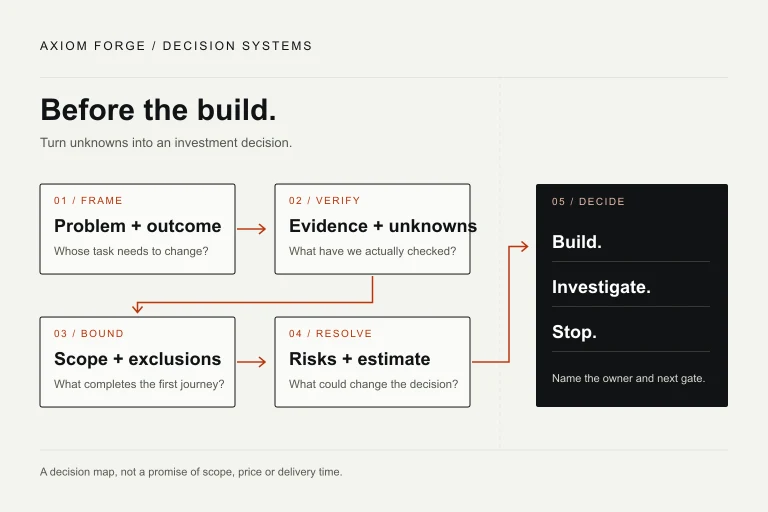
Our take
Buy discovery to reduce the uncertainty that can change your investment decision. A longer requirements document is not automatically a better result.
In this article
01 / 08
Start with the decision, not the slide deck
You are considering a customer portal, internal platform or mobile product. A supplier offers a discovery phase before quoting the build. That can be useful—but only if you agree what uncertainty it will remove and what you can do with the result. A workshop, a backlog and a polished deck are activities or artifacts. They are not, by themselves, evidence that development is the right next investment.
Before signing, finish this sentence: ‘At the end, we will decide whether to fund ___, based on evidence about ___.’ For a portal, the unknown may be whether customers can complete a task without calling an account manager. For an internal tool, it may be whether the source system exposes the data the workflow requires. These are different discoveries, even if both suppliers call the package ‘product strategy’.
The UK Government Service Manual frames discovery around understanding the problem, users and constraints before committing to build. That is useful process guidance, not a prescribed commercial timetable. Axiom Forge’s recommendation for private-sector buyers is to translate that principle into a small set of reviewable deliverables and an explicit investment decision.
02 / 08
Require these seven deliverables—and define what ‘accepted’ means
Use the following matrix as a starting point for the statement of work. Not every project needs the same document format. Every project does need an agreed way to distinguish completed investigation from an attractive summary.
| Deliverable | Minimum useful content | Acceptance question |
|---|---|---|
| Problem and outcome | Target users, current workflow, baseline and desired change. | Can the sponsor explain why this is worth solving? |
| Evidence record | Research notes, observed problems, limitations and unresolved assumptions. | Can we trace each important claim to evidence? |
| First-release boundary | One complete user journey, included work and explicit exclusions. | Can we describe what a user will actually finish? |
| System and integration map | Data owners, interfaces, access constraints and dependencies. | Have high-risk connections been checked, or clearly marked unknown? |
| Risk and security register | Failure modes, sensitive data, responsible owners and next checks. | Who resolves each material risk before launch? |
| Delivery and investment model | Work packages, assumptions, confidence ranges and review gates. | Can we see what would change the estimate? |
| Decision and handover pack | Recommendation, alternatives, editable files and access ownership. | Could another qualified team understand the next step? |
Assign a business approver to each row. The supplier can prepare the evidence, but cannot decide your acceptable operational risk, approve another team’s system access or invent the business baseline. Record missing decisions as open items rather than silently treating them as approval.
03 / 08
Make the scope traceable to a real workflow
A useful first-release scope follows a task from beginning to end. ‘Dashboard, notifications and administration’ is a feature list; it does not explain what someone accomplishes. ‘An account manager approves a customer request, sends it to fulfilment and sees a confirmed outcome’ describes a workflow that can be investigated and later accepted.
Ask the team to show the normal path, the exception path and the operational owner. What happens when information is missing? Who handles a rejected request? What remains manual? A small release with a complete recovery path is often more coherent than a large set of screens without operational ownership. That is a product judgment, not a universal requirement to automate every exception.
Separate three labels in the evidence record: observed, assumed and not yet tested. A stakeholder’s request is valuable input, but it is not proof that users share the same need. Keep interview notes or task observations appropriately anonymised; a handover does not need unrestricted copies of personal customer data.
For each included capability, add the reason it exists and a plain-language acceptance condition. Put tempting later features in a separate list with a reason for deferral. This is different from choosing the smallest possible MVP; it establishes the evidence and boundaries on which that later release decision depends.
04 / 08
Investigate the dependencies that can invalidate the plan
Integration work is especially easy to underestimate when discovery produces only screen designs. A named API is not enough. Request the interface owner, required permissions, sandbox availability, relevant limits, expected data freshness and how failures are handled. Mark whether each point was read in documentation, demonstrated in a safe environment or merely assumed.
Do not ask a discovery team to copy production records or share credentials in a document. Use approved access, synthetic examples or a controlled sandbox. The output should show what was verified and what still needs permission—not expose the access itself. If a critical interface cannot be checked, the estimate must retain that uncertainty.
Security belongs in this conversation before implementation. Identify who can access which records, how privileged actions are approved, which data needs protection and who owns incident response. NIST’s Secure Software Development Framework provides a shared vocabulary for discussing secure development with suppliers. Referencing it does not certify a vendor or replace the security review appropriate to your product.
A well-defined technical investigation has a question, a safe method, a time boundary and an evidence artifact. It should not become an unreviewed production implementation disguised as discovery. If a proposed integration fails its feasibility check, revise the solution or stop that scope before committing to the full build.
05 / 08
Example: a supplier portal with a hidden dependency
Illustrative scenario—not an Axiom Forge client result. A distributor wants suppliers to see purchase orders and update expected delivery dates. The initial request includes a dashboard, messaging, document uploads and real-time stock visibility.
Discovery identifies one priority journey: a supplier reviews an order and proposes a delivery date that the purchasing team approves. The system map then reveals that the existing ERP offers order exports, but write access requires a separate approval and has not been tested. ‘Real-time’ is therefore an unverified requirement, not a delivery commitment.
The handover offers three choices. First, launch a read-only portal with a clearly labelled refresh time and a manual date-approval process. Second, fund a narrowly scoped ERP feasibility check before deciding on two-way updates. Third, postpone the portal if manual reconciliation would create more work than it removes.
The value is not that discovery selected the most sophisticated option. It made the dependency, operating trade-off and next spend explicit. The sponsor can now compare the business value of earlier access against the cost and risk of integration. No invented conversion uplift or precision estimate is needed to make that decision useful.
06 / 08
Accept an estimate only with its assumptions and handover rights
An estimate should connect work packages to the proposed release, identify dependencies and state how uncertainty affects the range. Ask what is excluded: content preparation, migration cleanup, licences, hosting, accessibility review, support or internal staff time. A number without these boundaries cannot be compared meaningfully with another supplier’s proposal.
Agree the discovery fee and stop/go checkpoint separately from any later build commitment. There is no universal duration or price that makes discovery legitimate. A well-understood integration may need a focused investigation; a multi-party platform may need broader research. Require the supplier to explain why each activity is necessary for your decision rather than borrowing a standard package’s length.
Handover should include editable diagrams, prioritised requirements, design source files where commissioned, research summaries, the risk register and the basis of the estimate. Confirm permitted use, ownership and any third-party restrictions in the agreement. This is a procurement checklist, not legal advice; have the relevant terms reviewed for your contract and jurisdiction.
The practical acceptance check is portability: can your team inspect the work, retain the evidence and continue with a suitably qualified delivery partner? That does not mean every supplier must transfer its pre-existing tools. It means those exceptions are disclosed before you buy the engagement.
07 / 08
Run a decision review, then choose build, investigate or stop
Send the evidence pack before the final review so the meeting is not the first time the sponsor sees it. Invite the people who own the business outcome, operations, budget and any critical systems. Walk through the proposed workflow, the unresolved risks and the estimate assumptions before discussing attractive future features.
- Build: the outcome is valuable, the first release is coherent, dependencies are understood well enough and the remaining risk has an owner.
- Investigate: one unresolved issue could still change the solution or investment materially. Define a bounded follow-up rather than authorising the whole project.
- Stop or change direction: the need is weak, an existing product is a better fit, or the constraints outweigh the expected benefit.
Write down the decision, approver, reasons and conditions for reopening it. A ‘not yet’ decision can be a successful discovery outcome. The engagement has failed if nobody can say what was learned or why the next commitment is justified.
08 / 08
What to send when requesting a discovery proposal
Send a concise account of the current workflow, who uses it, what is going wrong, the outcome you want and the constraints you already know. Include existing diagrams or anonymised examples where helpful. Name the internal owner and the systems involved. Explain any target date and why it matters; do not turn a preferred date into an untested engineering assumption.
Ask each supplier to respond with the questions they will investigate, proposed evidence, required access, deliverables, exclusions and acceptance conditions. Comparing those responses is more useful than comparing workshop counts.
Axiom Forge combines product definition, design and engineering for custom websites, mobile applications and business software. For a private scope review, send your workflow and known constraints through the project brief or email hello@axiomforge.am. Do not send passwords, production exports or confidential customer records in an initial message.
Sources and editorial scope
This is Axiom Forge’s procurement and product-delivery guidance, not a guaranteed project plan. The example is illustrative. Sources checked on 4 Oct 2026.
- GOV.UK Service Manual — How the discovery phase works — Primary process guidance on understanding problems, constraints and the decision to proceed. Not a commercial timetable.
- NIST SP 800-218 — Secure Software Development Framework v1.1 — Primary reference for discussing secure development practices and supplier expectations; no certification is claimed.