Mobile Applications / Buyer’s guide
Mobile App Maintenance Agreements: What to Cover After Launch
Compare mobile app maintenance proposals: incident coverage, platform updates, release responsibilities, support capacity and a practical ownership checklist.
The short answer
A useful maintenance agreement names the systems and versions covered, who monitors them, how incidents are classified, when response clocks run, who approves releases, and what capacity is available. Separate defect correction, preventive platform updates and new features. A promise to respond is not a promise to restore service—or a guarantee of store approval.
Discuss your project ↗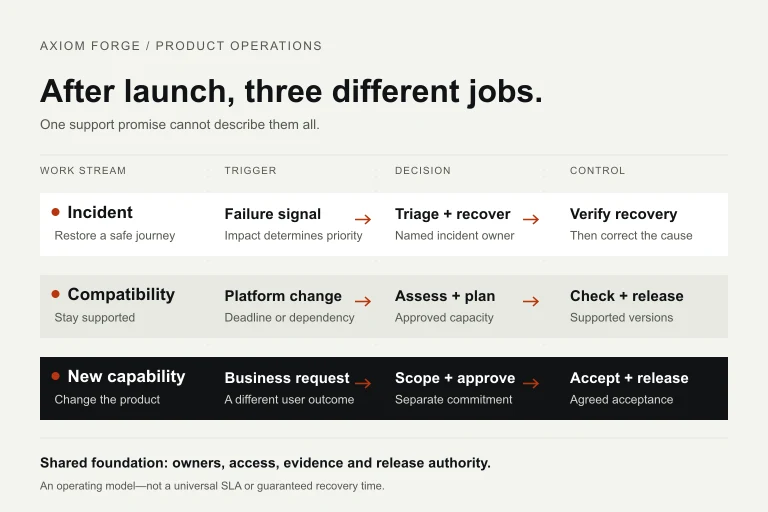
Our take
Buy a workable response system, not a line item called support. The app, backend, stores and business owner all need a defined role when something changes.
In this article
01 / 08
Separate repairs, preventive upkeep and new development
Your app is live, and a supplier offers a monthly maintenance package. Before comparing prices, ask what happens when checkout stops working, a platform requirement changes, or your sales team requests a new discount flow. All three create engineering work. They are not the same commercial obligation.
Defect correction addresses a failure against agreed behaviour. Record the acceptance baseline and any warranty conditions separately; the label ‘bug’ alone does not settle responsibility. Preventive maintenance keeps the supported product compatible with agreed operating systems, dependencies and store requirements. Enhancements change what the product does and need their own scope, approval and capacity.
Axiom Forge recommends classifying requests by effect on the user journey before debating their billing category. Restore a safe operating state first when the agreement authorises it; preserve evidence and settle the work classification transparently. An incident should not become a reason to approve unlimited new development.
02 / 08
Define the service boundary with a responsibility matrix
‘We maintain the app’ can mean only the mobile code, while the failure lives in an API, expired credential or third-party service. Name the production components, environments, supported app versions and device/OS coverage. The following is a starting allocation to negotiate, not a statement of Axiom Forge’s default contractual service levels.
| Work stream | Supplier responsibility to specify | Client responsibility to name | Evidence of completion |
|---|---|---|---|
| Production incidents | Monitoring scope, triage, authorised containment and escalation. | Business impact, incident contact and emergency decision authority. | Incident record, verified recovery and unresolved follow-up. |
| Platform and dependency upkeep | Watch relevant changes; assess, estimate and schedule required updates. | Approve the support window, capacity and compatibility policy. | Change register and checks on supported devices and journeys. |
| Backend and integrations | Own included services; coordinate with named external providers. | Maintain subscriptions and nominate owners of client-run systems. | End-to-end operation verified, not merely a healthy app process. |
| Store releases | Build preparation, submission support and post-release checks as agreed. | Retain account control; approve metadata, declarations and release. | Build/version record, review outcome and rollout decision. |
| New capabilities | Impact assessment and separately accepted delivery scope. | Priority, budget and acceptance decision. | Approved change and demonstrated user journey. |
For each row, identify the person or role that owns the next action. A supplier can coordinate a payment-provider outage without being able to repair the provider. Coordination should still produce a clear status and escalation path rather than an indefinite ‘waiting on someone else’ ticket.
03 / 08
Agree the incident clocks before agreeing their numbers
A proposal promising ‘fast response’ is difficult to enforce operationally. Even a numerical target is ambiguous until you define when it begins, whether it runs outside business hours, and what stops it. Specify the timezone, working days, holidays, intake channel and fallback contact. An unattended email inbox is not an on-call arrangement.
- Acknowledgement: someone accepts the report and names the incident owner. An automatic receipt is not necessarily human triage.
- Assessment: the team establishes affected versions, user impact, safe next steps and the next update time.
- Restoration: the agreed critical journey works again, potentially through an approved workaround.
- Permanent correction: the underlying fault is addressed and the correction is verified.
Classify severity using business impact, not who complains most loudly. A blocked core journey with no workaround warrants different treatment from a visual defect on one supported device. Specify who can raise or reduce severity and how disagreements are escalated. Where security or possible data loss is involved, route to the named security lead and the organisation’s incident procedure, rather than treating it as an ordinary feature ticket.
Negotiate actual targets against impact, staffing and the system’s recoverability. There is no responsible universal recovery time for every custom app. Store review and third-party outages are dependencies to report, not excuses to hide elapsed time. Agree which clocks pause, why, and what communication continues during the pause.
04 / 08
Put compatibility work on a calendar, not in the emergency queue
An unchanged feature set does not mean an unchanged operating environment. Someone must track the requirements that affect this app, record their applicability, and leave enough time to investigate and release an update.
For example, as checked on 5 October 2026, Google Play’s target API rules distinguish new submissions and updates from continued availability of existing apps. For ordinary mobile apps, the published requirements effective from 31 August 2026 specify Android 16/API 36 for new apps and updates, and Android 15/API 35 for the existing-app availability condition. Other device categories and extensions have separate conditions. Check the app’s Play Console and current policy rather than applying one number to every Android product.
Apple’s App Store Improvements process also evaluates whether apps remain functional, current and compliant. Its inactivity criterion combines no update within three years with a minimal download threshold; it is not a rule that every three-year-old app is automatically removed.
The maintenance output should be a dated change register: affected component, deadline or trigger, risk, proposed action, owner and approval status. Agree whether investigation, dependency upgrades, regression checks and store submissions consume the package’s capacity. Do not promise that a library upgrade is trivial until its effect on authentication, payments and other critical journeys is understood.
05 / 08
Choose reserved capacity, ad hoc work or on-call coverage deliberately
The support model should follow operational exposure. An internal app used during staffed hours may not need the same coverage as a customer service that accepts orders overnight. Decide which journeys cannot wait, whether a manual route exists, and who can operate it.
- Ad hoc work: suitable for infrequent, noncritical changes when the buyer can tolerate scheduling uncertainty. Agree the intake and estimate process; a supplier being available in principle is not reserved capacity.
- Reserved capacity: appropriate for regular upkeep and a predictable review rhythm. Specify what uses the allocation, queue priority, unused-capacity treatment and approval before overage.
- Explicit on-call coverage: consider it when consequential failures can occur outside normal hours. Define rota coverage, escalation, access and the permitted actions. Reserving development hours does not automatically provide on-call response.
A hybrid can separate scheduled compatibility work from incident coverage and separately funded enhancements. Compare like-for-like proposals using the same component inventory and scenarios, not a generic percentage of the original build price. Hosting, provider fees, store memberships and customer-service staffing may remain separate costs.
Request a reporting format showing work completed, capacity used, open risks and next decisions. If all capacity is repeatedly spent on the same failure, the next decision may be a targeted redesign rather than a larger maintenance allowance.
06 / 08
Example: a payment timeout needs more than an app update
Illustrative scenario, not a client case. A booking app times out after sending a payment request. The customer cannot tell whether the booking succeeded and tries again. The important question is no longer simply whether the loading indicator is broken: the team must establish the payment and booking states before encouraging retries.
The incident owner records affected versions and the time window, checks the server and provider status through authorised access, and coordinates with the business operator. An approved containment step might disable the affected payment route and show a truthful recovery message. Customer support uses a reconciliation procedure rather than guessing from a screenshot or issuing repeated charges. Sensitive payment data is not pasted into ordinary support tickets.
If the correction can safely be made on the backend, the team still verifies behaviour with supported installed app versions. If a mobile binary must change, the release depends on build checks, store review and distribution. Halting a Google Play staged rollout stops additional users receiving that version; it does not downgrade people who already received it. Apple’s phased release controls gradual automatic updates, while users can still manually download the update. Neither mechanism is a universal undo button.
The maintenance agreement should therefore name the containment authority, client decision-maker, release owner and customer communication owner. Closure requires evidence that the booking and payment records reconcile and the relevant journey works—not merely that a patch was uploaded.
07 / 08
Accept the support setup before the first incident
Before coverage begins, ask the incoming team to demonstrate that it can operate the included system. If it did not build the app, agree an initial assessment and record unknowns rather than treating inherited code as fully understood.
- The exact supported release, repository revision and production components are recorded.
- An authorised engineer can reproduce a build and explain the release process without the previous developer’s personal laptop.
- Scoped account access, recovery contacts and renewal owners are in place; passwords are not exchanged by email.
- Monitoring covers the critical user journey and dependencies, with an alert owner and a stated coverage window.
- A safe incident rehearsal confirms that the report reaches the correct people. Use a tabletop scenario or approved test environment, not a fake production outage.
- Recovery procedures include the data dependencies. A backup’s existence alone does not prove restoration; record the approved recovery check and its limitations.
- The severity rules, escalation contacts, change approvals and customer communication responsibilities are accessible.
Define the support review’s evidence: recurring incident causes, outstanding risks, supported-version changes, capacity use and decisions required from the client. Crash counts help investigation but do not alone describe whether a customer could finish the intended task. Select measures that connect technical failures to the product’s actual use.
08 / 08
Include an exit pack—and send a brief that can be scoped
Good support should leave the business able to change supplier. Specify a current system inventory, build and release instructions, known-issue register, dependency list, monitoring configuration and an access-transfer checklist. Agree transition work, timing and third-party restrictions; do not assume that maintenance automatically transfers every pre-existing supplier tool. Arrange credential rotation and removal of obsolete access through a controlled handover.
These are procurement and operating questions, not jurisdiction-specific legal drafting. Have the actual warranty, liability, service-level and ownership terms reviewed for your agreement. Our separate source-code ownership guide covers the rights and account-control discussion; this checklist covers what the team must be able to do after launch.
When asking for a proposal, send the app’s purpose, supported platforms, critical journeys, component inventory, current release process and required coverage. Share anonymised issue categories and known deadlines, not passwords or production exports. Ask the supplier to show how it would handle one incident and one compatibility update before comparing its price.
Axiom Forge’s mobile product development service connects release scope with backend, ownership and post-launch responsibilities. For a private review of a new app or an existing product, use the project brief or email hello@axiomforge.am. The first step is to establish the product and access constraints, not promise a support level before inspecting them.
Sources and editorial scope
This is Axiom Forge’s procurement and product-delivery guidance, not a guaranteed project plan. The example is illustrative. Sources checked on 5 Oct 2026.
- Google Play — Target API level requirements — Current submission and existing-app availability requirements; device-category conditions differ.
- Apple — App Store Improvements — Ongoing evaluation and the combined update/download criterion; no automatic three-year removal claim.
- Google Play — Staged rollouts — Halting limits further distribution without downgrading users already on the version.
- Apple — Release a version update in phases — Phased automatic distribution does not prevent manual downloads.