Enterprise Software / Buyer’s guide
Custom Software Backup and Recovery: What to Commission
Go beyond a backup badge. Define downtime and data-loss limits, recovery scope, responsibilities and a safe restore rehearsal for custom software.
The short answer
Commission a recoverable workflow, not just scheduled backups. Agree how long the critical work may stop and how much recent data may be unavailable; include files, configuration, access and external dependencies alongside the database. Require a controlled restore rehearsal with data checks and a completed business journey. Record who can authorise recovery, what the exercise proved and what remains outside the scope.
Discuss your project ↗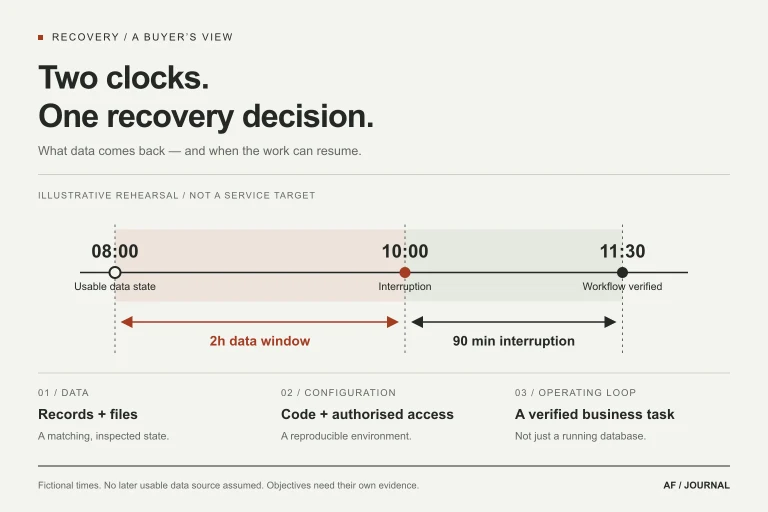
Our take
The useful buying question is not ‘Do you have backups?’ It is ‘Can an authorised team restore the agreed business workflow from the protected resources, verify its state and explain the gap?’ That evidence should be part of delivery, not discovered during the first outage.
In this article
01 / 08
Start with the work that must resume, not the backup schedule
A portal can be online while staff cannot open the documents needed to approve a request. A database can start while the application cannot authenticate users. ‘The server is back’ is therefore a weak finish line for a business recovery plan.
Name the smallest useful operating state: which users can do what, with which records and dependencies? An internal catalogue might resume read-only while editing remains paused. A booking system may need reliable availability and a controlled way to process new requests. State the exclusions and the manual alternative; a degraded mode is acceptable only if the business agrees to what it can safely do.
Then identify the failures the proposed protection addresses. Accidental deletion, a failed deployment, loss of an environment and unavailable access are different scenarios. A design that handles one does not automatically handle the others. Recovery following a suspected compromise needs an appropriate incident-response process and clean-state assessment, not an automatic restoration that assumes every recent copy is trustworthy.
Axiom Forge recommends recording these scenarios during product discovery. It is easier to price the operating boundary before development than to add it after a supplier has interpreted ‘hosting included’ as the whole requirement.
02 / 08
Separate the missing-data window from the interruption limit
Two decisions often get collapsed into ‘daily backup’. The NIST RPO glossary concerns the historical point to which data must be recovered. The RTO glossary concerns the time constraint on recovery before unacceptable business impact. For a buying discussion, translate these into the missing recent work the business can tolerate and how long the defined workflow can be unavailable.
Write an objective for each important workflow and scenario. Explain the consequences rather than choosing attractive numbers: can staff reconstruct missing requests from an authoritative source, are uploaded files reproducible, and what happens to customers while the service is paused? Agree how the elapsed-time clock starts and what observable state stops it. Approval and verification time should not disappear from the record because the technical restore finished sooner.
AWS’s recovery-objective guidance connects targets to business impact and dependent workloads, and warns against arbitrary or unrealistic objectives. Your application cannot promise a recovery path that requires an unavailable dependency unless an acceptable alternative is included.
An objective is a requirement, not evidence that the current system meets it. Report the latest exercise’s observed data point and elapsed time separately, along with volume, environment and limitations. Do not turn a successful small rehearsal into an unconditional zero-loss or instant-recovery guarantee.
03 / 08
Ask what is protected, reconstructible and outside the supplier’s control
This is Axiom Forge’s proposed commissioning worksheet. Complete it with the delivery and operating teams; ‘included’ needs a concrete method, owner and evidence. Not every component needs its own backup if it can be reliably rebuilt, but that rebuild route must exist.
| Dependency | Decision to document | Evidence to request |
|---|---|---|
| Database and history | Protected records, recoverable period, usable restore points and treatment of corrupt data. | Restored state with identifiers, relationships and meaningful totals checked. |
| Files and attachments | Where objects live, how they are protected and how their state matches database references. | Representative restored records open the expected files with correct access. |
| Application and configuration | Compatible code version, infrastructure, settings and rebuild dependencies. | Reproducible deployment of the version that can use the recovered data. |
| Identity, secrets and keys | Authorised emergency access, secure recovery of required key material and approval boundaries. | Named roles can perform the drill without a former supplier’s personal account. |
| External systems and pending work | Authoritative records elsewhere, queues, safe replay and reconciliation responsibilities. | No real outgoing effects during the drill; discrepancies and duplicates are accounted for. |
| Operating and recovery evidence | Alert owner, runbook, verification criteria, recurring exercise and retention of its record. | Dated results, measured clocks, unresolved gaps and assigned follow-up. |
Keep permissions and protected-data handling in scope. Restoring an old copy should not silently re-enable an obsolete user or expose documents to a broader audience. Define how current access decisions and required deletion or retention decisions are reconciled before normal use; qualified specialists should determine legal requirements for the actual organisation.
A provider may protect its service without offering every customer the granular restoration or export your workflow requires. Check the actual product, plan, terms and restore procedure. ‘Managed database’ is not a specification for the whole application.
04 / 08
Choose the protection method for the failure it can address
Periodic copies can be a reasonable choice when the accepted missing-data window and demonstrated restore time fit the workflow. Ask about failed jobs, copy age, retention, access isolation and recovery cost—not merely how often the scheduler runs. A job that failed unnoticed changes the actual recoverable point.
Where the database supports it, point-in-time recovery can provide more choices of historical state. It has its own dependencies. PostgreSQL’s documentation, for example, describes recovery using a base backup and the required continuous sequence of archived write-ahead logs. It also notes that WAL recovery does not restore manually changed database configuration files. This is a PostgreSQL-specific example of why the recovery inventory must extend beyond transaction data, not a claim that every hosted database offers the same feature.
Failover serves another purpose: continuing service after particular infrastructure failures. A synchronised copy may also receive an unwanted application change or deletion. Unless a separate historical recovery path is included, switching to that copy does not by itself undo the mistake. Ask which scenarios are demonstrated, not whether the proposal uses the phrase ‘high availability’.
The supplier should compare implementations against the agreed objectives, operating capacity and dependencies. More frequent protection, retained history, independently controlled copies and standby capacity introduce work and running costs. Do not buy the most elaborate option without a justified need, or select the cheapest storage line while omitting the people and procedures needed to recover it.
05 / 08
Commission a restore rehearsal that cannot trigger live business actions
The exercise should use an approved isolated destination with an agreed data-access policy. Prefer representative synthetic or appropriately minimised data where it can establish the required evidence. If protected real data is necessary, authorise its handling explicitly, restrict access and agree removal of temporary resources. Do not improvise a production outage to prove the plan.
Before loading the recovered application, the delivery team should prevent real email, payment, CRM and other outward-facing actions through the environment’s permissions and connectivity, not merely a note in the runbook. Old queued work or restored credentials can otherwise turn a drill into a real event. Use sandbox destinations and controlled test identities for the intended checks.
- Identify: record the scenario, protected resources, backup identifiers, data point, application version, destination and people authorised to proceed.
- Recover: execute the documented route, including access, environment preparation and compatible application configuration. Record manual interventions and timing.
- Inspect data: check representative records, relationships, attachments and business totals against the expected source state. A database process starting is not enough.
- Complete the workflow: an intended operator performs the agreed task through the recovered application, including the receiving test system where applicable.
- Account for the gap: identify records after the restored point and external events needing reconciliation. Demonstrate a safe procedure rather than assume they can all be replayed.
- Close: record the verified state, elapsed time, limitations, corrective owners and controlled teardown. Keep evidence without unnecessary personal data.
AWS’s backup-recovery guidance explicitly distinguishes having a backup from restoring and checking usable data against the objectives. The exercise above extends that check to the commissioned business journey; it is Axiom Forge’s proposed acceptance method, not proof of a service we have performed for a named client.
06 / 08
Example: a ninety-minute restart leaves a two-hour data gap
Fictional simplified rehearsal—not a client result. Assume the latest usable, matching database and attachment state is 08:00, service interruption begins at 10:00, and an operator verifies the agreed recovered workflow at 11:30. No later usable recovery source is available in this example.
The verified interruption lasts ninety minutes. The restored state is two hours behind the interruption. Those are separate observations. Calling it a ‘ninety-minute recovery’ does not tell the buyer whether requests created between 08:00 and 10:00 are available. Calling the data copy ‘today’s backup’ hides the same issue.
Now suppose a connected external service processed events during that missing window. Reopening the application with its older state cannot reverse those external events. The team needs an authoritative comparison and an authorised way to resolve differences before enabling outgoing work. Blindly replaying old tasks could duplicate actions; blindly dropping them could lose necessary work.
A decision record would compare both observations with the agreed objectives and record the unresolved reconciliation work. The outcome might be to improve protection, accept a restricted operating mode or revise the objectives with informed business approval. The times in this example are neither recommended targets nor a price or delivery promise. In a real exercise, use the actual verified recoverable state—not the nominal schedule time.
07 / 08
Keep the recovery path current after the launch review
A change in data volume, application version, file storage, authentication or external dependency can invalidate assumptions from the last drill. Assign an owner to review that impact. Agree an exercise cadence and change-triggered checks according to the system’s consequences and operating capacity; this article does not prescribe a universal interval.
Monitor protection failures, aging recovery points and the resources needed to restore. Distinguish a successful copy from a completed recovery exercise in the dashboard and report. Define where alerts go, the coverage window and what happens when the primary engineer is unavailable.
Protect the copies as sensitive assets. Specify who may read or remove them, how necessary keys remain recoverable and how retention is managed. Independently controlled recovery resources may reduce shared failure exposure, but the proposed isolation and access must be assessed for the actual scenario. Encryption is not a useful recovery control if the required keys cannot be recovered by authorised people.
The maintenance agreement guide covers ongoing duties and incident handling. The ownership guide covers rights and account control. Recovery adds a distinct requirement: another authorised team must be able to use the documented protection and rebuild path, not simply possess the source repository.
08 / 08
Make recovery evidence a deliverable in the software proposal
Ask for separate scope lines for workflow impact assessment, protection setup, secure recovery access, runbook, rehearsal, recurring checks and external-system reconciliation. Include storage, retained history, restore resources and engineering effort in the running-cost comparison. No single percentage of development cost can describe all these systems responsibly.
The acceptance pack should identify the evaluated configuration, covered scenarios, objectives, observed results, exclusions and next exercise owner. Accept the agreed scope when the evidence supports it; require remediation when an essential step fails; revise scope only with a clear account of the operating consequence. A vague ‘backups included’ statement should not substitute for that decision.
If the business does not have the capacity to maintain a proposed custom system, revisit the operating model before buying it. The build-or-buy framework helps compare that responsibility with a configurable product. Buying a managed service still requires checking what the customer can recover.
For a private scoping discussion with Axiom Forge’s custom software team, send the critical workflow, known data stores and integrations, acceptable interruption and missing-data concerns, and the current protection arrangement if known. Use the project brief or hello@axiomforge.am. Share an anonymised description, not credentials, keys or production exports. That gives us a recovery boundary to investigate rather than an unsupported promise to restore anything instantly.
Sources and editorial scope
This is Axiom Forge’s procurement and product-delivery guidance, not a guaranteed project plan. The example is illustrative. Sources checked on 10 Oct 2026.
- NIST — Recovery Point Objective — The historical data point required after an outage; not a proven property of a backup schedule.
- NIST — Recovery Time Objective — Recovery-time constraint in its business-impact context.
- AWS — Define recovery objectives for downtime and data loss — Objectives should reflect workload impact and dependencies, not arbitrary or unachievable promises.
- AWS — Perform periodic recovery to verify backups — Restore and validate usable data against objectives rather than infer recovery from a backup badge.
- PostgreSQL — Continuous archiving and point-in-time recovery — Database-specific base-backup/log dependencies and configuration limits; not a universal provider capability.