Mobile Apps / Buyer’s guide
Account Deletion Is a Workflow, Not Just a Button
Scope account deletion in a mobile app: request flow, connected services, retention decisions and completion evidence. A practical guide for product buyers.
The short answer
Commission a complete deletion journey, not only an account-settings button. Define how a request is verified, when access ends, which systems must act, what exceptions have an approved basis and how completion is checked. Give delayed or failed work an owner and an honest status. Apply each store’s requirements and obtain product-specific advice on retention and deadlines; a generic workflow is not proof of legal compliance.
Discuss your project ↗
Our take
A disappearing profile is not enough evidence that the request has been fulfilled. Scope the work behind the confirmation message before promising what that message means.
In this article
01 / 07
The profile disappears. Has the account actually been deleted?
Imagine reviewing a new mobile app. You tap ‘Delete account’, confirm, and arrive at the sign-in screen. The demonstration looks finished. But the support platform still has a profile, a second device still has a session, and an export job is waiting to run.
This is an illustrative scenario, not a client incident. It shows why account deletion belongs in the product scope early: the visible action and the work behind it are different deliverables.
Logging out ends a session. Deactivation can stop access while leaving an account in place. Subscription cancellation concerns billing. Deletion has its own data-handling scope. A product can need several of these actions, but it should not quietly substitute one for another.
Axiom Forge’s recommendation is to review this journey alongside registration—not at the end of release acceptance. Every extra system that receives account data can add another decision, dependency or verification step.
02 / 07
Separate store requirements from your own retention decisions
Apple’s account-deletion guidance requires apps supporting account creation to let people initiate deletion in the app; temporary deactivation alone is insufficient. It allows identity and intent checks, but not unnecessary obstacles. Apps outside highly regulated industries should not force a support conversation. If processing takes time, explain that and confirm completion.
Google Play’s User Data policy requires an in-app and external request route for apps within its account-creation scope, with associated user data addressed rather than merely freezing the account. Its deletion requirements FAQ explains the web resource and policy exceptions. A user should not have to reinstall the app to submit the external request.
These are platform policies, not a universal statement of privacy law. Which records must be retained, for what purpose, for how long and under which restrictions depends on the product and applicable obligations. Have those decisions reviewed by qualified advisers. Do not let a developer invent a retention period—or use ‘compliance’ as a blanket reason to keep everything.
In the brief, record the approved handling and required user explanation for each category. Store review, legal review and engineering verification answer different questions; none substitutes for the others.
03 / 07
Map the data before deciding what ‘done’ means
Start with a compact data-disposition matrix. The table below proposes questions to settle, not default permission to retain records or a prescribed deletion schedule.
| Account footprint | Decision to agree | Evidence to request |
|---|---|---|
| Identity and access | When sign-in stops and how sessions, devices and linked authentication are handled. | A second session cannot continue using the retired account. |
| Profile and files | Which personal fields, uploads and generated copies must be removed, and from where. | Checks cover the agreed stores, not only the profile screen. |
| Connected services | Which processors receive a deletion action, who owns it and how failures are handled. | The dependency result is recorded; unresolved work is visible. |
| Shared content | What happens to posts, attachments and records visible to other people under the applicable rules. | The agreed outcome is checked from another permitted viewer. |
| Retained records | The specifically approved basis, restricted use, access and expiry for each exception. | An exception record explains what remains and who approved the handling. |
| Backups and restoration | How the approved retention schedule and restore process prevent unintended reactivation. | A safe recovery rehearsal respects completed deletion decisions. |
| Completion record | The minimal proof needed to track fulfilment without preserving the deleted profile unnecessarily. | Status distinguishes verified completion from acceptance of the request. |
Put an owner beside each system in the project’s actual version. ‘Backend’ is not an accountable person, and a third-party SDK is not outside the scope merely because the app team did not write it.
For Sign in with Apple, include its own revocation flow rather than assuming that removing a local database row revokes the provider’s tokens. Apple’s TN3194 describes that boundary and handling when tokens are unavailable. The integration needs its own reviewed implementation.
04 / 07
Make the request clear without making deletion reckless
A good confirmation explains the specific consequence in ordinary language. Which account is involved? What access or content will be lost? What approved exception remains? If work is not immediate, how will the person learn the result?
Our design recommendation is a proportionate identity check, an explicit confirmation and a clear exit from the dialog before commitment. Avoid vague buttons such as ‘Continue’ at the irreversible step. Equally, do not turn verification into a retention funnel full of repeated persuasion or unrelated questions.
After confirmation, the service needs a durable request identity and a controlled execution path. Decide when new account activity is prevented, how outstanding work is resolved and what the person sees if the network drops after the request was accepted. A second tap should not create contradictory jobs.
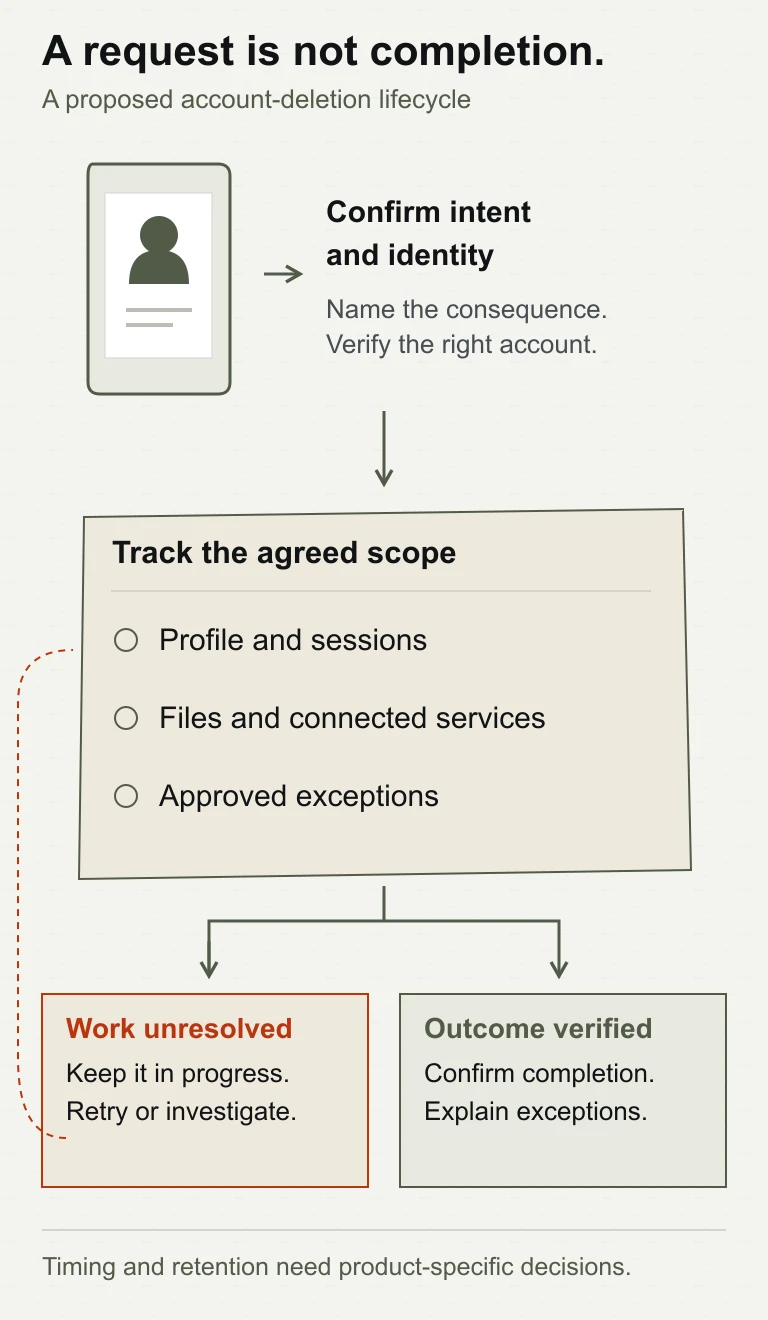
Fast automated execution can suit a simple product with known dependencies. A tracked background process can handle longer work and controlled retries. Neither approach earns a truthful ‘complete’ label without checking the agreed scope. Do not promise a duration before the systems and obligations are understood.
06 / 07
Treat billing and a future return as separate decisions
Do not tell a person that deletion automatically cancels every subscription. For Apple auto-renewable subscriptions, its guidance says to warn about continuing billing and provide the cancellation route. Scheduling deletion around expiry must not remove the immediate-deletion option. Other billing arrangements require their own verified handling.
For the delivery scope, name the purchase channels, subscription-state checks, relevant user explanation and support responsibility. The engineering team should not silently decide refunds, outstanding balances or legal record retention. Obtain the appropriate commercial and specialist decisions before finalising the flow.
Also rehearse a later sign-up with the same email or identity provider. Should it create a genuinely new account? Could a delayed event attach old data to it? Our recommendation is to distinguish the retired internal identity from a new registration and verify the agreed behaviour. An email address alone should not become an accidental instruction to revive the former profile.
If a shared workspace or organisation is involved, define the scope precisely: one person leaving must not silently delete everyone’s project. Resolve ownership transfer and permitted retained business records with the responsible owners rather than hiding the issue behind a generic confirmation.
07 / 07
Accept the complete journey—and keep its owner after launch
Ask the supplier to demonstrate the workflow with synthetic accounts in an isolated environment. No real customer should be deleted to prove that a demonstration works. Keep expected outcomes, the exact build, observations and unresolved limitations with the acceptance record.
- Findability: the app route and required external route are discoverable and identify the right product.
- Authority: another person cannot delete the account by changing an identifier; identity and intent checks match the approved design.
- Interrupted request: a timeout or duplicate submission has a clear result without contradictory work.
- Other device: the retired identity cannot continue using an old session after the agreed access cutoff.
- Dependent failure: an unavailable service produces visible pending work and an owned recovery path.
- Data outcome: files, shared surfaces and approved exceptions match the disposition matrix.
- Billing and return: the explanation is accurate, and later registration does not silently resurrect old data.
- Completion: the confirmation reflects checked outcomes, not only a queued job.
The proposal should include the inventory, policy decisions needed from the client, interface, server orchestration, third-party work, safe verification and operating handover. New integrations can change this scope after launch; keep it in the maintenance responsibility record.
When discussing mobile app development, send the account types, sign-in providers, purchase channels and connected systems you expect to use. Start with a project brief or email hello@axiomforge.am. Please do not send credentials or real customer records.
Sources and editorial scope
This is Axiom Forge’s procurement and product-delivery guidance, not a guaranteed project plan. The example is illustrative. Sources checked on 16 Oct 2026.
- Apple — 5.1.1(v): Offering account deletion in your app — Current account-deletion entry, confirmation, processing and subscription guidance; platform policy, not universal legal advice.
- Google Play — User Data policy — Account-deletion scope, associated data and disclosure of necessary retention.
- Google Play — Understanding app account deletion requirements — External deletion resource, user access without reinstalling and policy exceptions.
- Apple — TN3194: Account deletions and Sign in with Apple token revocation — Authentication-provider boundary and revocation handling; implementation requires its own review.