AI & automation / Buyer’s guide
Nemotron Bolt: A 4GB Model Is Not a 4GB Product
NVIDIA’s October 23 Bolt release makes local AI worth a closer look. Before buying into 4GB, separate the model, context, runtime and complete product workload.
The short answer
Nemotron 3.5 Bolt E4B is a plausible candidate for a bounded local-assistant trial. Its 4GB positioning is not a universal whole-app memory requirement or an offline guarantee. Request measurements for the exact model file, runtime, device, context and surrounding application. This is a documentation-based review, not our own Bolt benchmark.
Discuss your project ↗
Our take
Local inference changes where generation happens. It does not make the rest of the product—or its operating responsibilities—disappear.
In this article
01 / 06
The model fits. The kiosk still has to run.
Consider an illustrative museum information kiosk. The team wants an assistant that answers questions from an approved exhibit catalogue, even when the building’s internet connection is unreliable. A compact local model sounds attractive: fewer remote dependencies and a tightly bounded task.
But the model does not get the device to itself. The visitor interface, catalogue, operating system and inference runtime still need resources. Add spoken interaction and there may be separate speech components as well. A successful model demonstration is not yet evidence that the complete kiosk remains responsive through a busy afternoon.
That is the useful question behind NVIDIA’s new Bolt release: not simply whether a small model can answer, but whether a particular local product can do its job within an explained resource and connectivity boundary.
Review boundary: sources checked on 25 October 2026. We have not downloaded or run Bolt, profiled a device or reproduced the benchmarks. The kiosk and the evaluation below are illustrative recommendations.
02 / 06
An October 23 checkpoint release, not a new announcement today
NVIDIA’s official research post dates this release to 23 October. It positions Bolt E4B around low-memory conversational agents, multi-turn tool use and configurable reasoning. This is a specific model release, not merely the earlier Nemotron family announcement.
The official model repository provides a Q4_K_M checkpoint and describes text input and output, up to 64K context and separate thinking and conversational controls. It builds on Gemma 4 E4B. An accompanying robot demonstration should not be read as proof that this checkpoint itself accepts camera images or audio.
There is independent attention beyond the launch post: AtomicAgent published a small local-agent experiment on October 23, and a LocalLLaMA thread discusses the release. Their activity makes the release worth examining; it is not evidence that our kiosk works.
Compared with buying access to a hosted model, a downloadable checkpoint lets a team investigate a more directly controlled inference environment. It also moves runtime integration, device compatibility, updates and capacity planning into the product’s own scope. That trade is the subject of this review—not a claim that local is always preferable.
03 / 06
NVIDIA’s own table explains why 4GB needs a workload
The release’s performance table reports different peak VRAM figures for different conversation workloads on the same GPU:
| NVIDIA workload | Cached / new input / output | Reported peak VRAM |
|---|---|---|
| Short interaction | 0 / 3K / 50 tokens | 3.5 GB |
| Longer history | 32K / 2K / 256 tokens | 4.3 GB |
These are NVIDIA’s measurements on an RTX 5070, using Q4_K_M, batch size one, llama.cpp with CUDA and AIPerf. They are not our results, download sizes or a total kiosk memory budget. The figures should not be transferred to a different device or workload as a guarantee.
The lesson is narrower and more useful than a recommended RAM number: ‘fits’ needs an exact configuration. A short conversation, a long retained history and concurrent visitors can have different resource demands. If the demonstration uses one session, do not assume it establishes the capacity for several.
Ask the supplier to identify the model artifact and quantisation, runtime build, device, accelerator settings, context limit, output allowance and concurrency. Request the observed memory type and peak under that configuration, together with how it was measured. A memory reading without those conditions is difficult to compare or reproduce.
04 / 06
Budget the device, not only the model file
Separate storage from running memory. The file you download occupies disk; the running system also needs a model representation, working buffers and context storage. GPU memory, system RAM and unified memory are different resource arrangements, so ask which one each reported number describes.
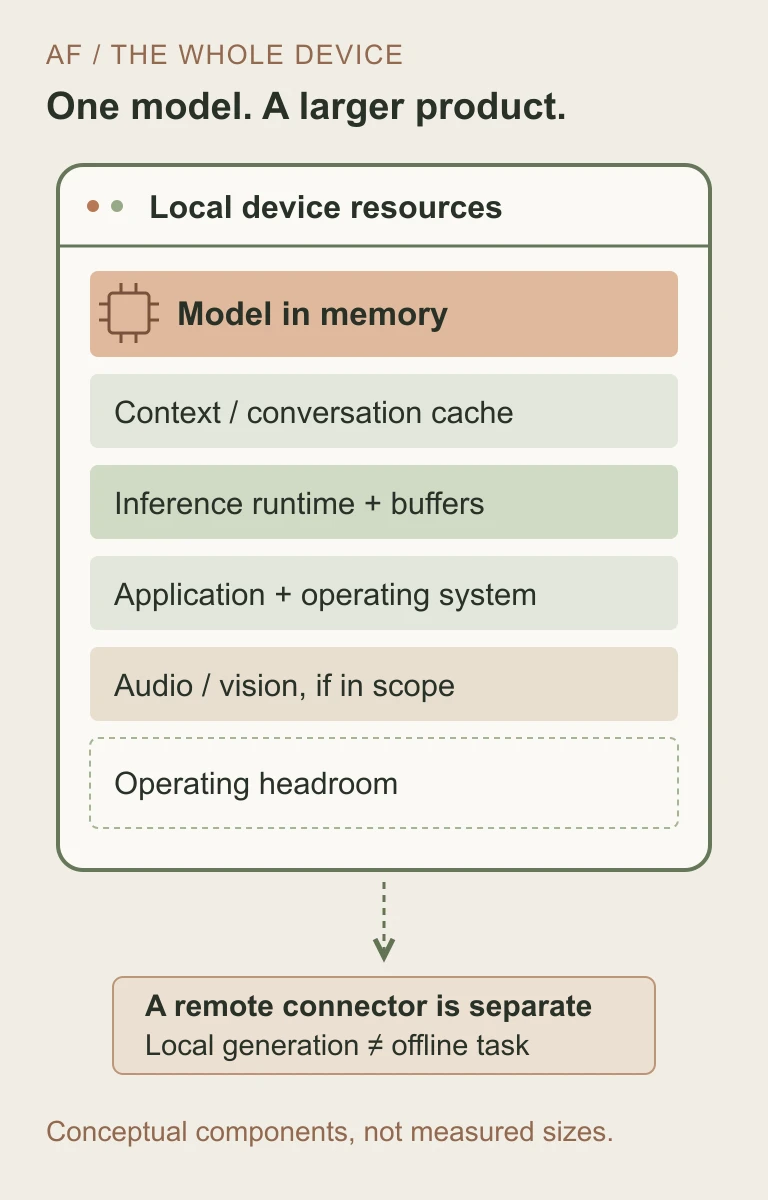
In the kiosk, the question is whether the complete visitor task stays usable while those components coexist. Look at cold start, a growing conversation, application navigation and recovery after a failed request. Include the selected speech pipeline only if spoken interaction is actually part of the first release.
Optional accelerators or companion models also belong in the measured configuration rather than disappearing into the model’s headline. A comparison using a different precision or an extra helper model is a different system. The separate BF16 model card primarily positions that full-precision artifact for customisation and post-training; do not assume its resource profile is the compact checkpoint’s.
For a continuously available installation, also agree the actual operating conditions: power, cooling, background work and a recoverable application state. A fast initial reply on a development machine is not evidence of a responsive unattended device.
05 / 06
Local generation is not the same as an offline workflow
Our museum assistant can be designed to read an approved catalogue already stored on the kiosk. A request for live opening hours from a remote service is different. The model may still generate words when the connection disappears, but that does not make those hours current.
Draw the boundary around data and actions, not around the chat window. Which information is local? How is it refreshed? Which functions work without a connection? What does the visitor see when an answer requires a remote lookup? If an external model fallback is proposed, make its activation, data destination and user-facing explanation explicit.
A local installation also needs a data policy. Check whether prompts, logs, crash reports, analytics or update mechanisms leave the device. Do not infer that all information stays private merely because token generation happens locally. Equally, do not assume that every local product needs a cloud fallback; a clear refusal can be the more appropriate boundary.
The offline-first commissioning guide covers the larger synchronisation problem. For this kiosk, the smaller initial promise might simply be: answer from the approved local catalogue and say when a question needs unavailable live information.
06 / 06
Ask for one exact device and one useful task
A sensible trial starts with a non-confidential catalogue, the intended hardware and a small group of real visitor questions. Agree how the assistant should handle absent facts, ambiguous requests and an unavailable dependency. If it can call functions, the application must still enforce which actions are permitted; choosing a local model does not establish that authority.
Keep three outcomes separate in the trial record: answer quality, task completion and resource behaviour. A compact resource footprint does not excuse an unsupported answer; an accurate answer does not excuse an unresponsive interface. Use the AI acceptance guide to define evidence without turning a few successful examples into a universal score.
Review the exact distribution terms as well. The checkpoint card names OpenMDW 1.1; the hosted API card names separate trial terms. Downloadable weights, a hosted trial and a supported production service are different purchasing routes. This review establishes neither a universal access entitlement nor a price for your deployment.
Bolt merits a look when local inference addresses a concrete constraint. It is less compelling if the team is choosing hardware and accepting operating complexity solely to avoid an unmeasured cloud cost. Compare the complete alternatives after the task and resource boundary are clear.
For an AI-assisted application or business system, send the intended device, information sources and customer action through the project brief, or write to hello@axiomforge.am. The useful deliverable is a working, explainable product slice—not a model name followed by a memory number.
Sources and editorial scope
This is Axiom Forge’s procurement and product-delivery guidance, not a guaranteed project plan. The example is illustrative. Sources checked on 25 Oct 2026.
- NVIDIA — Nemotron 3.5 Bolt E4B 4GB release, October 23 — Primary date, product positioning and conditional VRAM measurements. The table reproduced here is attributed vendor evidence, not an Axiom Forge benchmark.
- NVIDIA — official Bolt checkpoint and model card — Primary artifact, modality, context and governing licence information. Availability of weights does not prove suitability for a particular device or workload.
- NVIDIA — hosted/BF16 model card — Separate full-precision artifact positioning and hosted trial terms; not interchangeable with the compact checkpoint.
- AtomicAgent — bounded local-agent experiment, October 23 — Dated independent interest and a third party’s limited experiment. We did not reproduce it and do not adopt its results as our own.
- LocalLLaMA — public release discussion — Community discussion used as an attention signal, not as the source of capability claims or fixed popularity metrics.