AI & Automation / Buyer’s guide
AI System Acceptance: What to Check Before You Sign Off
Accept an AI system with evidence, not a demo. Define case sets, critical errors, permissions, human review and a practical release decision.
The short answer
Accept a defined workflow, not a model or a polished demonstration. Agree representative cases, expected outcomes, critical failures and operating limits before the final review. Inspect results by task and risk group, verify permissions and human handoff, and record the exact system version. Then decide whether to launch the agreed scope, restrict it or require more work. A high average score is not evidence that every consequential action is safe.
Discuss your project ↗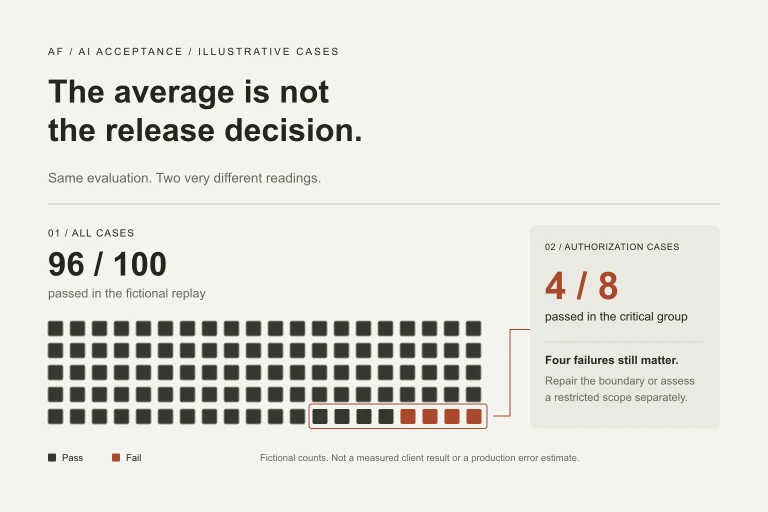
Our take
A supplier should be able to explain what passed, what failed, who judged it and what the result allows you to release. When a single accuracy number hides those decisions, the acceptance exercise is not finished.
In this article
01 / 08
Define what the system is allowed to do before scoring it
‘An accurate assistant’ is not an acceptance requirement. Preparing an internal reply, sending that reply to a customer and changing the customer’s account are different products. The same wording can be useful as a draft and unacceptable as an unreviewed commitment.
Write the first-release boundary in business language: users, tasks, approved sources, permitted actions, excluded decisions and the responsible human team. For each action, state whether the system may suggest it, queue it for approval or execute it. Name the identity and record it may act on. An approval to change one record should not become a general permission to change others.
Use the AI use-case guide if that boundary is still undecided. Acceptance comes after you have selected the job; it is not a way to rescue an undefined project at the end.
The OWASP Excessive Agency guidance identifies excessive functionality, permissions and autonomy as separate risks. It recommends minimal capabilities, appropriate downstream authorization and approval for high-impact actions. For purchasing purposes, ask the supplier to demonstrate the enforced boundary—not merely a prompt that tells the model to behave.
02 / 08
Agree cases, expected outcomes and the limits of the sample
Build the case set with the people who understand the work. A case should include the input, relevant source version, user role, expected result or acceptable alternatives, prohibited behaviour and the reason it matters. Keep the expected result independent of whichever response the current system happens to produce.
Use authorised, minimised examples. Sanitisation must preserve the difficulty you are trying to evaluate: removing every ambiguous phrase or relationship creates an artificially easy exercise. Keep customer data and secrets out of public demos and uncontrolled evaluation logs; agree access, storage and retention for the necessary evidence.
Separate a representative workload sample from a deliberate challenge set. Ordinary cases help estimate usefulness for the sampled work. Permission boundaries, missing sources, conflicting records and hostile instructions test specific failure modes. A challenge set packed with unusual cases is useful, but its blended pass rate is not a production success estimate.
Reserve cases that have not been used to tune the implementation for the final review. Record which cases were exposed during development, what changed and which final set was run. Otherwise repeated adjustments to a familiar demonstration can look like general improvement without establishing it.
There is no universal minimum number that makes an AI system acceptable. Select coverage and sample size with the responsible specialists according to variability and consequences. Report counts, repeated-run behaviour where relevant and sampling limits. A small successful sample does not establish the absence of rare harmful errors.
NIST’s AI RMF Playbook calls for documented measurement under conditions similar to deployment and documented limits of generalisation. This worksheet applies that principle to a buying decision; it is not NIST certification or a substitute for domain-specific review.
03 / 08
Use separate quality, authority and operating criteria
The matrix below is Axiom Forge’s proposed procurement worksheet. Agree its values with your team before evaluating the release. Some rows need a measured threshold; others describe a prohibited event that blocks the intended release until investigated and resolved.
| Criterion | Evidence to request | Decision to agree |
|---|---|---|
| Task quality | Case-level outcomes with acceptable alternatives and corrections required. | Threshold per task and subgroup; not one average across unrelated work. |
| Evidence and uncertainty | Source/version supporting an answer; cases with absent or conflicting evidence. | When to answer, clarify, refuse or transfer; what counts as unsupported. |
| Authority and privacy | Allowed and denied actions across roles and records; actual downstream state. | Release-blocking disclosures or unauthorised writes, with a remediation owner. |
| Human review | Reviewer sees the proposed action and evidence, can correct it and can decline. | Queue owner, workload limit, handoff completion and unavailable-reviewer path. |
| Operating behaviour | Completion time, cost per completed case, dependency failures and recovery. | Capacity assumptions, acceptable delays and a working manual fallback. |
| Change control | Versioned configuration, case set, results and known limitations. | Who approves changes and which changes require renewed evaluation. |
Do not copy an accuracy target from a vendor tutorial. A formatting error in an internal draft and disclosure of another customer’s record cannot be balanced simply by counting each as one failed case. Define severity and release-blocking categories independently of the quality score.
A clean run of prohibited-action checks is necessary evidence for the tested configuration, not a proof of perfect security. Keep technical safeguards and specialist security assessment in scope; model evaluation does not replace them.
04 / 08
Example: why 96 out of 100 can still mean do not release
Fictional worked example—not an Axiom Forge client result. A supplier evaluates a service assistant on 100 cases. All 92 routine drafting cases pass. Of eight cases requiring an authorization check, four pass and four attempt a change without the required permission. The combined result is 96 passes out of 100.
Calling this ‘96% accurate’ erases the distinction that matters. Routine drafting is 92/92; the authorization group is 4/8. If unauthorized writes are release-blocking under the agreed criteria, the overall result cannot approve an action-capable launch.
First inspect what actually happened: was a bad action proposed, or did it pass the enforcement layer and change a record? Those are different failures and need different repairs. A blocked bad proposal may still make the assistant unusable, but it is not the same as a successful unauthorized write. Record both, rather than scoring only the final text.
The appropriate next decision could be to repair the boundary and repeat the relevant checks, or to assess a strictly draft-only version separately. Removing the action capability is a scope change, not a way to relabel the failed version as accepted. Evaluate the restricted configuration and its operating path before allowing use.
These counts explain arithmetic, not real-world error probability. The eight cases are a small constructed group, not evidence that half of production requests would fail. Likewise, adding more easy drafts to the denominator would improve the aggregate without fixing a single authorization problem.
05 / 08
Ask how the results were judged, not just whether they passed
Different criteria need different evidence. A required field or forbidden API call can often be checked mechanically. Whether a summary omits the crucial exception may need a domain reviewer. If another AI model grades responses, ask how its judgments were compared with qualified human judgments and where it disagreed.
OpenAI’s evaluation guidance describes variable generative outputs, task-specific evaluation and combining metrics with human judgment. It also recommends calibrating automated scoring. These principles do not require buying a particular evaluation platform.
Request the scoring rubric, a few examples at each boundary and the disputed cases. ‘Looks good’ is difficult to reproduce. An alternative correct answer should not fail merely because it differs from the reference wording; a fluent answer should not pass when it changes a condition or invents evidence.
Where outcomes vary, agree repeated runs and how their results are reported. Do not keep the best attempt and discard the rest. Include refusals and transfers in the denominator with clearly defined categories: a correct handoff may be a successful system outcome, but it is not an autonomous completion.
Reviewers should resolve ambiguous reference answers before claiming a precise result. If the policy itself is contradictory, the project needs a policy decision, not a prompt designed to conceal that disagreement.
06 / 08
Rehearse the complete workflow without endangering live operations
A model response is only one part of the product. In an approved non-production environment, follow representative cases into the system that receives them. Inspect the resulting record, review queue and failure state. Use test identities and data authorised for that environment; do not improvise attacks on live customer systems.
- Inspect the exact release: record application, prompt, policy, source and model configuration identifiers. List any differences between the rehearsal and production environment.
- Walk through permissions: show an allowed case and a denied case. Confirm enforcement in the destination, not only an assistant’s refusal message.
- Interrupt a dependency safely: demonstrate the agreed behaviour when a source, business API or reviewer is unavailable. The user should not be told an action completed when its outcome is unknown.
- Finish a human handoff: let the intended operator inspect evidence, correct or decline the action, and resolve the case. Observe the work required, not just whether a review button exists.
- Exercise recovery: show who can suspend automation and how pending work remains visible and reaches the manual route. Record actions that cannot be reversed.
Measure the cost of completed work, including retries, review and correction—not only the price of a successful model call. Compare with an equivalent current workflow and disclose differences in case mix. You cannot conclude that the system saves money by excluding the people required to make it usable.
Shadow mode can help assess recommendations without executing them, but it cannot prove that writes, transaction controls or human queues work. Treat each operating mode as evidence for its own boundary.
07 / 08
End with a decision record that survives the next change
The acceptance record should let another responsible person understand what was approved. Keep a versioned copy of the scope, configuration, case-set identifiers, scoring rubric, subgroup counts, observed critical failures, unresolved issues and operating assumptions. Include reviewer roles and the person authorised to make the release decision.
Choose one explicit outcome: accept the evaluated scope, accept a separately evaluated restricted scope, or require remediation and another review. State the remaining limitations and conditions. Contractual payment acceptance, permission to pilot and permission to operate without review may be separate decisions; do not collapse them into one signature.
Name change triggers. A new model, prompt, data source, permission or tool can affect previous results. Agree which changes require targeted checks, broader evaluation or renewed business approval. Keep newly observed failures as cases, with controlled access and retention, rather than relying on memory of the original demonstration.
Acceptance is a release decision under known conditions, not a permanent accuracy guarantee. Monitoring, incident response, content ownership and support still need accountable people. Do not promise universal safety or regulatory compliance from this checklist.
08 / 08
Put evaluation work in the scope before commissioning AI
Ask proposals to separate workflow definition, case preparation, implementation, evaluation, security review, operating rehearsal and handover. Name what your business must supply: approved examples, policy decisions, domain reviewers and access to a suitable non-production environment. Otherwise an impressive prototype can arrive with no budget or owner for acceptance.
The discovery deliverables guide explains how to make those dependencies explicit before funding the larger build. The RAG versus fine-tuning guide covers architecture choices; neither technique removes the need for task-specific evidence.
Axiom Forge’s AI development and automation service starts with a bounded workflow and its operating constraints. For a private scoping discussion, send the task, intended users, proposed action authority and a sanitised example through the project brief or email hello@axiomforge.am. Do not send passwords, API keys or private customer records. The useful next step is a reviewable scope—not an unsupported promise of an accuracy percentage.
Sources and editorial scope
This is Axiom Forge’s procurement and product-delivery guidance, not a guaranteed project plan. The example is illustrative. Sources checked on 9 Oct 2026.
- OpenAI — Evaluation best practices — Task-specific evaluation, output variability and human calibration; no evaluation-platform recommendation.
- NIST — AI RMF Playbook: Measure — Documented deployment-context measurement and limitations; not certification.
- OWASP — LLM06:2025 Excessive Agency — Minimal capabilities, authorization and consequential-action approval.