AI & Automation / Buyer’s guide
Voxtral 3 Connects the Conversation. Who Owns the Action?
Mistral’s October 20 voice release joins speech and tools. Here is what changes for a service workflow—and what a buyer still needs to specify before a pilot.
The short answer
Voxtral 3 makes a modular voice pipeline easier to assemble: transcription, a reasoning model with tools, and speech output. That is a useful integration change, not proof of a reliable business service. Before a pilot, define caller authority, confirmed changes, uncertain tool results, human handoff and the evidence needed to call a task complete. This is a documentary analysis, not our hands-on test.
Discuss your project ↗
Our take
The voice can sound certain before the business system is. Design the product so its actions—and its answers—respect that difference.
In this article
01 / 06
‘Done’ is a dangerous word when the save is uncertain
A customer calls a repair service to change the access instructions for a scheduled visit. They correct the job number halfway through saying it. Then they interrupt the assistant to change ‘side entrance’ to ‘reception’. The system submits an update, but the tool times out.
Should the assistant say the instructions have changed? Retry the write? Ask the customer to start again? A natural voice does not settle any of those questions.
This is an invented product scenario, not a client event or a test result. It is a useful way to read Mistral’s new Voxtral 3 release: not just as a better voice, but as a new option for connecting a conversation to an operational system.
Scope of this article: documentary analysis based on public sources checked on 22 October 2026. We did not run the models, place calls, measure latency or validate a production integration.
02 / 06
What arrived on October 20—and why it merits a look
Mistral’s model lifecycle records 20 October 2026 as the release date for the Voxtral 3 transcription and speech-generation variants. This is the event date, not merely the date an article about them was crawled.
The launch announcement introduces a LiveKit-based voice SDK joining realtime transcription, a separate general-purpose model that reasons and calls tools, and text-to-speech. Rather than manually connecting every speech stage, a team can start with a coordinated streaming pipeline. The components remain distinct; it is not one model that independently owns your business process.
The release also drew a substantial Hacker News discussion, visible in the dated October 20 archive. That is evidence of developer attention, not evidence of accuracy, adoption or suitability for your customers.
For a buyer, the useful change is packaging: less speech-pipeline assembly to evaluate before a conversational workflow can be explored. It does not remove the work of connecting the right customer record, applying business rules or recovering from an uncertain operation. Compare that complete delivery scope with your current approach, not just the attractiveness of a voice demo.
03 / 06
Available, active and proven are different claims
The current realtime transcription card is marked Public Preview / Premier and describes turn detection, context biasing and speaker diarization in a WebSocket session. The TTS card carries the same preview label. ‘Active’ in a lifecycle table should not be read as a general-availability or service-level promise.
The announcement describes API availability through European, US and global endpoints, with on-premises or private-cloud deployment discussed through Mistral’s team. Do not translate that into an assumption of publicly downloadable weights or automatic eligibility for every account and region. Confirm the exact model, access terms and data route for the intended deployment.
There is a practical documentation question to resolve too: the announcement describes TTS in 35-plus languages, while the current TTS card summary says nine. Those public statements do not establish a single reliable coverage list. Before promising multilingual service, confirm and evaluate the specific language, dialect, names and number formats your workflow needs.
Mistral’s speed and quality claims are vendor claims, not measurements from this article or a guarantee for a full call with your integrations. A short speech delay can coexist with a slow record lookup or a blocked handoff. Judge the customer’s complete turn and completed task, not one component’s headline latency.
04 / 06
Put a deliberate boundary between a sentence and a write
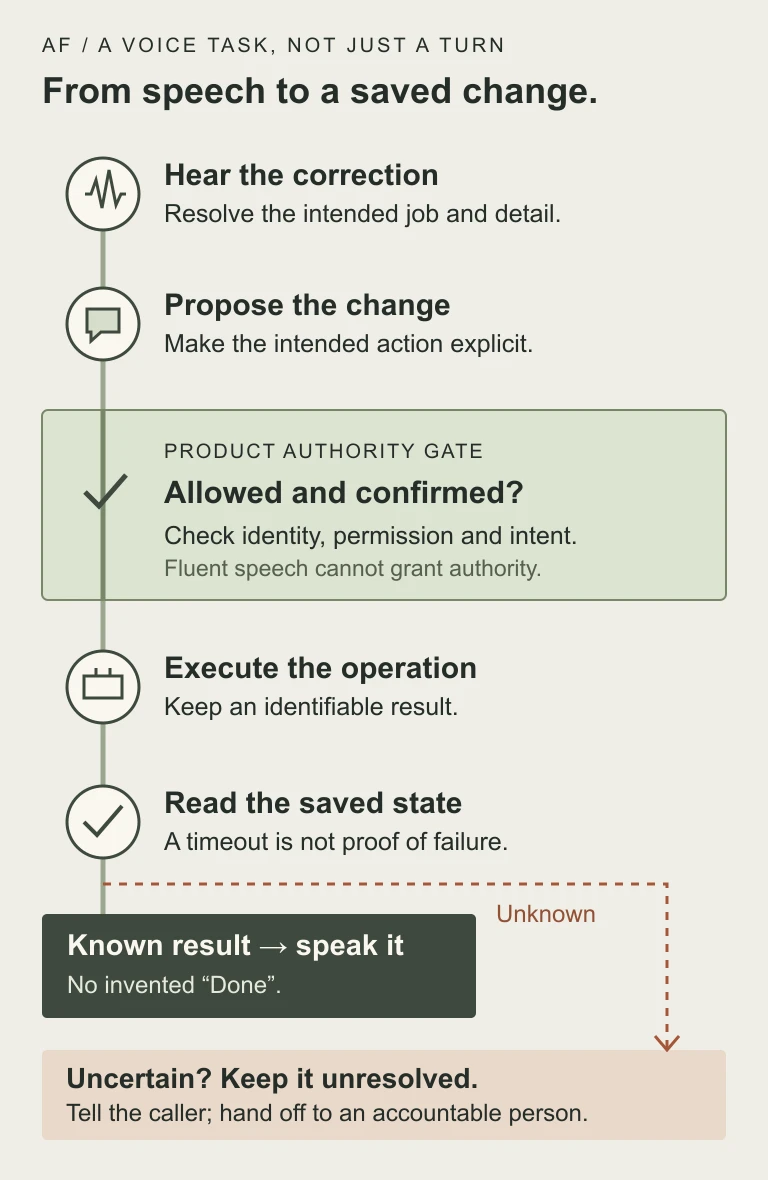
In the repair-call example, first establish which job the caller is allowed to change. A plausible job number and a confident voice are not sufficient authority. The product needs an approved identity and permission path, enforced by the connected service—not invented by the model during the call.
Then separate a proposed change from a committed one. Read back the relevant instruction in a form the caller can correct. Decide what happens if they interrupt before confirmation, after submission or while an update is still pending. Stopping spoken audio is not the same as cancelling a tool action already sent.
If the write times out, the application needs a way to discover whether it happened before repeating it. An identifiable operation, safe repeat behaviour and a read-back of the saved state may be appropriate parts of that integration. If the outcome cannot be established, report that uncertainty and route it to an accountable person. Do not fill the silence with a fictional success.
These are Axiom Forge product recommendations, not claims that the SDK automatically supplies them. Our permissions guide covers authority boundaries; the integration delivery guide explores why a repeated delivery and a repeated business action need different treatment.
05 / 06
Buy a bounded pilot, not a persuasive demonstration
A read-only service-status enquiry can be a different first step from changing a visit, authorising a refund or making another consequential decision. Select a narrow workflow with a recoverable failure path, a named human owner and clear exclusions. Voice cloning is not necessary just to establish that a service workflow is useful; if it is proposed, require appropriate speaker permission and review before using it.
Use synthetic records and approved participants. This table is our proposed pilot evidence, not a completed evaluation or a comprehensive safety certification.
| Pilot moment | Required product decision | Evidence to inspect |
|---|---|---|
| A number is corrected mid-sentence | The corrected identifier is resolved before selecting or changing a record. | Recognised correction, authorised target record and no update to the first interpretation. |
| The customer interrupts | Audio interruption and action cancellation have distinct, documented meanings. | The actual pending/committed state, not only whether speech stopped. |
| A write times out | The agent does not invent success or blindly repeat a possibly completed action. | Operation trace, saved-state check and an explicit unresolved outcome when needed. |
| The voice is fluent but the task fails | Completion is defined by the receiving business system. | Correct saved instruction, customer confirmation and relevant receiving-system result. |
| A person must take over | The handoff has an owner, useful context and a fallback when nobody is available. | What the operator receives, what remains pending and what the caller is told. |
Inspect these outcomes across the actual languages, audio conditions and integration behaviours in scope. Define what audio, transcripts and operation traces may be retained, who can access them and for how long, with the responsible privacy and security reviewers. A choice of inference region alone does not describe the whole path through telephony, observability and your business systems.
The broader AI acceptance framework can hold that evidence. Keep the results of this specific voice pilot separate from vendor benchmarks and anecdotes about previous speech models.
06 / 06
Price the service you need to operate
As checked on 22 October, the realtime card lists $0.008 per minute and the TTS card lists $13 per million characters. Those are different component units, not a complete cost per successful service call.
Before comparing proposals, specify which packaged or component route is being priced and what it includes. Ask about reasoning, voice-session infrastructure, telephony, integrations, observation, human fallback and ongoing support. Do not add component prices on top of a packaged quote without checking what is already included. Also count unresolved calls and operational review, not just inexpensive audio processing.
Our view: Voxtral 3 is worth a focused evaluation when voice fits a real customer or staff task and the business can provide an accountable action boundary. If the existing system has no dependable way to confirm, inspect or safely recover a change, improve that interface before promising that a conversational layer will make it reliable.
Axiom Forge’s AI and automation service can discuss that workflow, its integration boundaries and a suitable pilot. Send the intended task, existing system and failure constraints through the project brief or hello@axiomforge.am. Do not send live recordings, personal customer records or credentials in an initial brief. A discussion is not a completed experiment or a promise to replace a service team.
Sources and editorial scope
This is Axiom Forge’s procurement and product-delivery guidance, not a guaranteed project plan. The example is illustrative. Sources checked on 22 Oct 2026.
- Mistral — Voxtral 3 launch — SDK architecture, API/deployment routes and vendor claims. Not independent performance evidence.
- Mistral Legal Center — Voxtral 3 lifecycle — Official event date: 20 October 2026; Active model status.
- Mistral Docs — Realtime Transcribe 3 — Current Public Preview label, streaming features and component pricing.
- Mistral Docs — TTS 3 — Preview, price and language-summary discrepancy with the announcement; confirm the intended language rather than assuming coverage.
- Hacker News — Voxtral 3 discussion — Independent discussion and attention only, not proof of the product’s capabilities.
- Hacker News — 20 October archive — Dated corroboration of public interest in the launch.