Enterprise Software / Buyer’s guide
Who Can Approve, Edit or Export? Decide Before You Build
Define roles, record access and approval rules before commissioning business software. A practical permission matrix and acceptance guide for buyers.
The short answer
Do not stop at a list of roles. Agree who may perform each action, on which records, in which state and under which exceptions. Treat approval, export and access administration as separate decisions. Ask for permitted and denied examples, server-side enforcement evidence and a named owner for rule changes. The result is a permission contract the business can review—not a promise that a login screen makes the system secure.
Discuss your project ↗
Our take
A role name is a starting point, not a complete grant of authority. Buy a system that reflects the decisions your organisation has actually agreed to delegate.
In this article
01 / 07
The manager can sign in. Can they approve their own request?
Imagine a company commissioning an internal purchasing tool. The proposal includes employees, managers and administrators. In the demonstration, a manager creates a request and approves it immediately. The screens work. The business rule is still unresolved.
This is a fictional example, not an Axiom Forge client incident. Some organisations require a different person to approve a request; others permit self-approval within a defined boundary. The point is not to invent a universal rule. It is to make the actual rule explicit before the supplier builds an assumption into the product.
‘Managers can approve’ leaves important questions open. Which team’s requests? At which stage? Can an approver also change the amount? What happens when the approver is absent? Does an administrator inherit commercial approval authority merely because they manage accounts?
Axiom Forge recommends resolving one real workflow before multiplying roles across a platform. Walk from draft to submitted, approved, rejected and cancelled. Name who can cause each transition and what information they need. That discussion is part of product scope, not a small setting to tidy up at the end.
02 / 07
A permission needs a person, a record and an action
OWASP distinguishes authentication from authorization: establishing identity is different from deciding whether an action is permitted. A successful sign-in does not grant access to every resource.
For the buyer, the useful sentence is concrete: ‘An assigned approver may approve a submitted request in their department, provided they did not create it.’ The role, record boundary and condition are all visible. ‘The app has role-based access’ is not an equivalent specification.
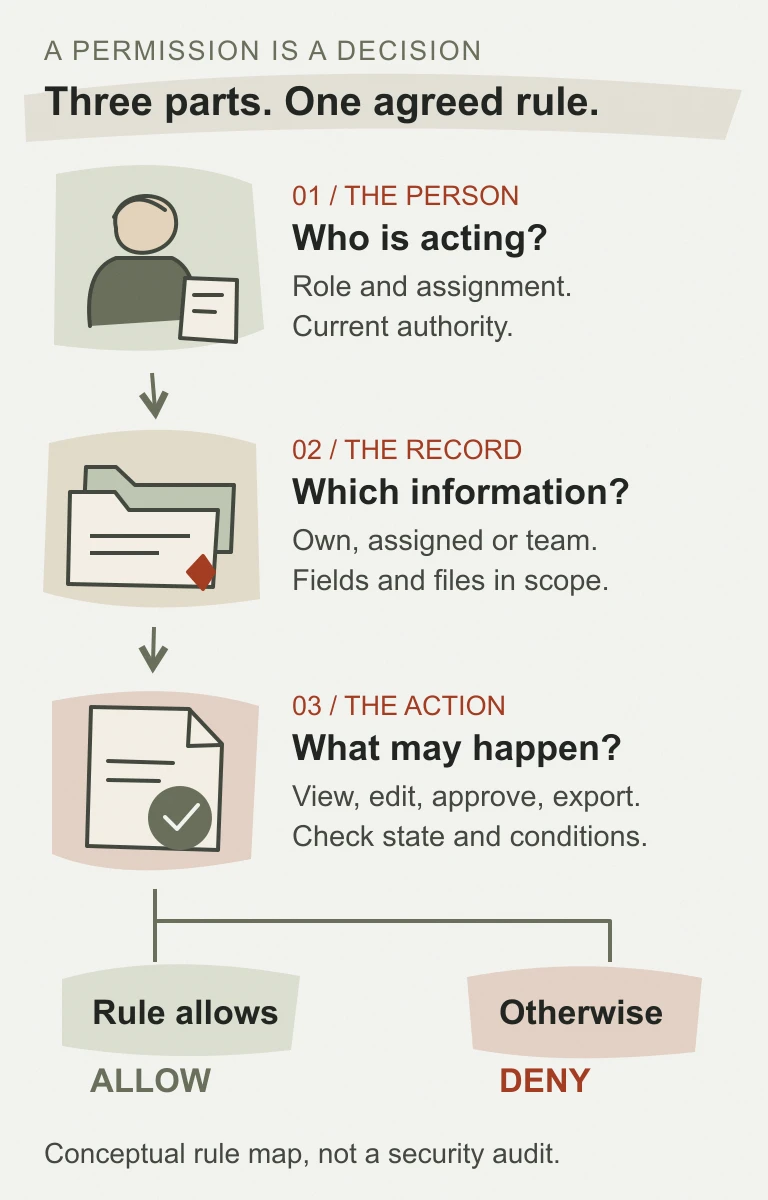
Choose the boundaries that matter to your operation: own records, assigned cases, one department, one customer organisation or a separately agreed cross-company scope. Decide whether a person may see a summary without seeing sensitive fields. Treat a file download as part of the same discussion.
The example above is Axiom Forge’s scoping device, not a required architecture. It gives the engineer something precise to implement and the sponsor something precise to challenge. It also exposes where the business itself has not yet decided who is responsible.
03 / 07
Write the permission contract in business language
Start with a short matrix for the first workflow. The rows below are illustrative: they describe a possible purchase-request process, not a recommended control scheme for every company. Review the real boundaries with the people accountable for the work.
| Person or role | Agreed action and scope | Boundary to decide explicitly |
|---|---|---|
| Requester | Create and edit their own draft; submit it for review. | What may change after submission? Can the request be withdrawn? |
| Assigned approver | Approve or reject submitted requests within an assigned department. | Self-approval, reassignment, value limits and unavailable approvers. |
| Finance reviewer | See the agreed financial fields for approved requests. | Whether export is allowed and which fields it includes. |
| Access administrator | Manage specified memberships and role assignments. | Whether they can grant their own authority or read business records. |
| Integration identity | Exchange only the records and operations needed by a named connection. | Its scope, credential owner and behaviour when authority is removed. |
Do not make each cell a vague ‘yes’. Name the object, action and condition. Read, edit, approve, cancel, download and export are different permissions. A bulk action deserves its own review because its effect is not the same as opening one record.
Add an example of something the role must not do. That single column often reveals disagreement faster than a polished role diagram. Keep unresolved questions visible as scope decisions with an owner, rather than allowing development to choose policy accidentally.
Attach the approved matrix to discovery and acceptance records. When a new team, record type or integration is added, revisit its rows. The discovery deliverables guide explains how to turn such decisions into reviewable project evidence.
04 / 07
Keep roles simple without pretending context disappears
A small set of roles can be easy for an operations team to understand. Difficulties appear when ‘manager’ means different things by branch, assignment or workflow state. Creating a new role for every combination may make the configuration harder to explain than the business process.
NIST’s ABAC guide describes decisions using attributes of the subject, object, requested operation and, where relevant, environment. Its definition provides a useful vocabulary for contextual rules; it does not require every commercial project to buy a particular policy engine.
Axiom Forge’s recommendation is to describe the rule first and choose the implementation second. If access follows assignments, those assignments need an authoritative source. If approval changes with the request state, the state must be defined consistently. A rule based on unreliable organisational data is not a finished permission design.
Ask for the trade-off in the proposal. Simple role bundles reduce configuration work when the boundaries are genuinely simple. More contextual rules can express the operation more accurately, but add mapping, administration and verification work. Do not purchase complexity for its own sake—or remove a necessary boundary merely to fit a convenient component.
Changes matter too. If someone moves departments while a request is open, decide what happens to their current assignments and access. The supplier should record the agreed behaviour, not assume that yesterday’s membership remains sufficient forever.
05 / 07
The awkward edges usually belong in the first estimate
A permission model can look complete until someone exports a report, delegates work for a holiday or administers an integration. Include these operations in discovery if the first release needs them; otherwise name them as exclusions rather than implied capabilities.
Export is a separate decision
Ask which records and fields leave the application, in what format and for which role. Decide whether generated files remain accessible after authority changes. Do not assume that permission to view an individual record also settles bulk export, attachment download or reporting access.
Delegation should have a boundary
For the fictional approval workflow, a substitute might receive only a named colleague’s pending assignments for an agreed period. Define who may appoint the substitute, whether self-approval is still prohibited and what happens at expiry. ‘Temporarily make them an administrator’ is not a neutral shortcut.
Administration is not business approval
Discuss account management, role assignment and exceptional access separately from ordinary operational duties. If emergency access is needed, agree its authorisation, scope, expiry and review. Avoid an undocumented escape route whose behaviour is known only to the developer.
Give integrations their own line in the scope. Identify the service identity, operations and records it needs; do not borrow an employee’s broad permissions simply because the connection runs without a person on screen. These are Axiom Forge’s commissioning recommendations, not claims that this article establishes a complete security or compliance programme.
07 / 07
Give the rules an owner after launch
The permission contract needs someone who can approve changes. A new department, outsourced team or reporting feature can alter the intended boundary even when the screens barely change. Agree who requests a change, who approves it, who implements it and what evidence is retained.
Discuss audit events as a designed feature. OWASP’s logging guidance covers authorisation failures, privileged actions and data exports, while warning against recording secrets and sensitive data indiscriminately. Decide event access and retention for the actual product and applicable obligations; a log is not automatically a trustworthy or complete audit trail.
For the fictional approval process, the business might need to explain who attempted or performed an approval, on which request, when and under which rule. That does not mean copying the whole request, credentials or private attachments into general telemetry. Decide what evidence is necessary and how it is protected.
Put the work into the proposal: rule discovery, administration screens, directory or account integration, field and record restrictions, verification, documentation and ongoing changes. More teams and exceptions affect the scope; this guide offers no universal delivery time or fixed price. Compare the operating requirement with the build-or-buy decision before commissioning a custom platform.
For a private review with our custom software team, send a redacted workflow, role list and examples of allowed and prohibited actions through the project brief or hello@axiomforge.am. Please omit passwords, personal customer records and live access tokens. We can discuss the permission decisions and delivery scope that need to be resolved.
Sources and editorial scope
This is Axiom Forge’s procurement and product-delivery guidance, not a guaranteed project plan. The example is illustrative. Sources checked on 14 Oct 2026.
- OWASP — Authorization Cheat Sheet — Identity versus authority, least privilege, default denial and server-side request enforcement. Not a certification claim.
- NIST SP 800-162 — ABAC Definition and Considerations — Attribute-based decision vocabulary; the 2019-updated publication is not a mandate for a particular commercial architecture.
- OWASP — Logging Cheat Sheet — Relevant security and operational events, sensitive-data exclusions and protected log access.