AI & automation / Buyer’s guide
GPT-6.1 Terra Can Compare Product Photos. Which Variant Should It Choose?
OpenAI released GPT-6.1 Terra on 26 October. A buyer’s analysis of photo-to-catalog matching, hidden variants, useful abstention and evidence before adoption.
The short answer
GPT-6.1 Terra is a new model candidate for visual catalog assistance, not a guarantee of exact product identification. Use a photo to propose matches from real catalog records, then verify the attributes that distinguish the variant. Keep an explicit ‘need more information’ or ‘no match’ route. Product identity, compatibility and current availability must not be inferred from resemblance alone.
Discuss your project ↗
Our take
The useful result is not always a selected SKU. Asking for the missing label or dimension can be the correct completion of a photo-matching task.
In this article
01 / 06
The lamp looks right. The model number is still missing.
A customer sends a photograph of a lamp in a room. Your catalog contains a small and a large version with almost the same silhouette, several glazes and region-specific electrical variants. The photograph may reveal the family while hiding the attribute that decides what you can actually supply.
This is an illustrative catalog scenario, not an Axiom Forge customer experiment. It is also a useful way to read OpenAI’s latest release: a model that can compare images may help narrow the search, but the product still needs a definition of an acceptable match.
The wrong design forces every photograph into one confident product choice. A better design can return a supported candidate, a short clarification request or no reliable match. That distinction matters before an answer is copied into a listing, quote or order.
02 / 06
What arrived on 26 October
The official API changelog dates GPT-6.1 Terra’s release to 26 October 2026. The model documentation lists text and image inputs, text output, and product-photo matching among its intended uses. Tool calling requires the Responses API.
OpenAI’s current guide recommends comparing GPT-6.1 Terra with GPT-5.6 Terra on representative images and workflows at the same reasoning effort. That is a more useful migration starting point than assuming a headline result transfers to your catalog.
The release has fresh public attention, including BleepingComputer’s 26 October coverage and a public Codex discussion. Those sources establish discussion, not independent evidence that the model correctly identifies your variants.
This article is a documentary analysis, not a hands-on test. The change worth evaluating is a newly released model for an existing visual-comparison problem—not a ready-made OpenAI storefront feature, and not proof that manual checking can be removed.
03 / 06
Give the model a catalog, not permission to invent one
Axiom Forge’s proposed workflow starts with actual, permitted catalog records: identifiers, reference images and distinguishing attributes. The model helps compare the supplied evidence. Its candidate must refer back to one of those records, rather than generate a plausible product name that the store then treats as an item.
For the lamp, an explanation such as ‘similar base profile and shade shape’ is useful supporting detail. It is not evidence of the hidden electrical specification. Ask for the missing label, a measurement or another relevant view where the image cannot settle the distinction.
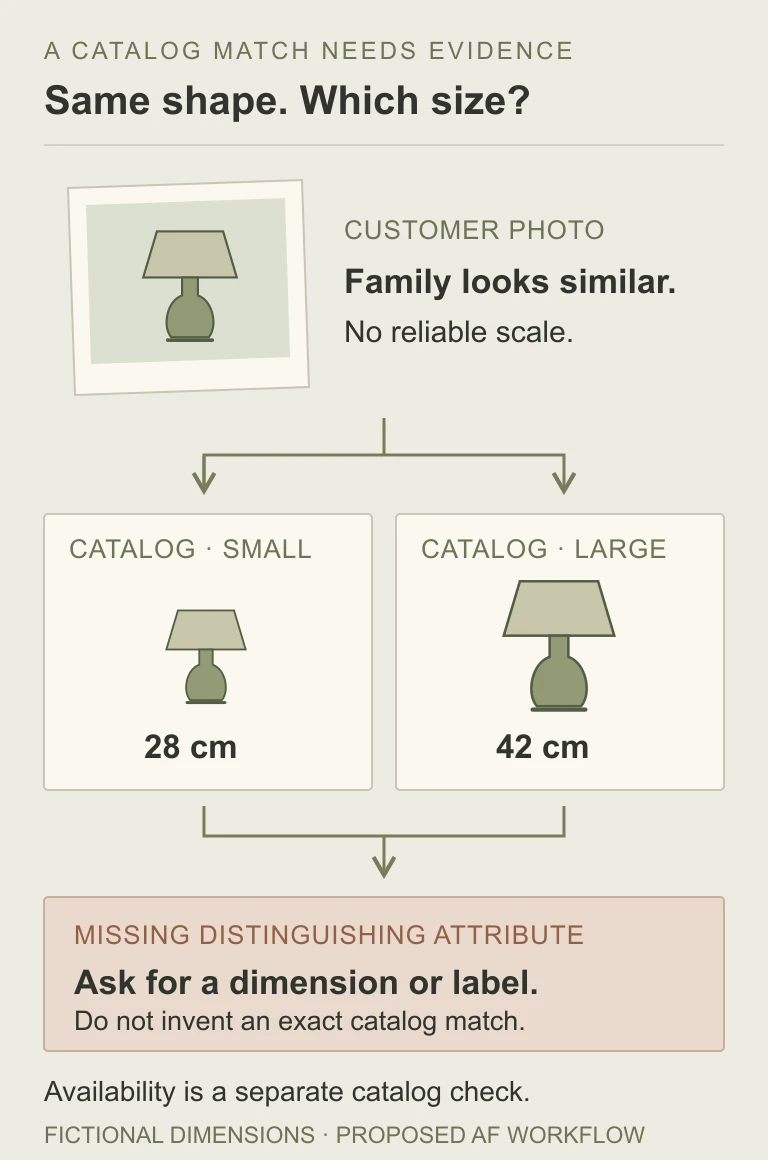
Keep three questions separate. Identity asks which record this appears to be. Suitability asks whether it meets the customer’s requirements. Availability asks what the business can currently supply. Even a correct visual match does not answer the other two.
If the model proposes several candidates, make the unresolved distinction visible. A shortlist of twenty unexplained near-duplicates only moves the search burden to another screen. The useful output helps the operator decide what evidence to obtain next.
04 / 06
Make the difficult photograph part of the pilot
Build a small, representative set with known catalog answers and known ambiguities. Include ordinary customer photographs, not just clean supplier images already present in the catalog. Agree the allowed action for each case before comparing models.
| Photograph or catalog case | Useful outcome | Evidence to request |
|---|---|---|
| Distinct item | Propose the correct existing catalog record with a visible basis for the comparison. | The returned identifier exists, refers to the intended variant and is traceable to supplied evidence. |
| Look-alike variants | Keep the exact variant unresolved when the deciding feature is absent. | The workflow asks for the specific missing measurement or label instead of forcing a choice. |
| Item is absent | Say that no supported catalog match was established. | No invented SKU or nearest-looking substitute is presented as the exact product. |
| Partial or poor view | Explain what additional view would make the comparison useful. | Any candidate remains clearly provisional; the operator can retain the request without accepting it. |
| Catalog state changes | Separate recognition from the current commercial offer. | A discontinued or unavailable item does not silently become an available substitute or an order. |
Measure wrong-variant decisions, useful clarification requests, missed valid matches and operator effort. A system can look accurate by refusing nearly everything, or look efficient by guessing on every image. The business needs to see both the useful completions and the cost of its errors.
Do not accept a model-written confidence percentage as the evaluation itself. Compare the outcome with known records and the agreed action. The AI acceptance guide covers that broader evidence discipline; this pilot applies it to one specific visual decision.
05 / 06
A trial in Work and an integration in your store are different scopes
OpenAI’s Work update documents Terra in ChatGPT Work and Codex, not ordinary Chat. Enterprise access depends on workspace and administrator controls; browser and computer use have their own setup requirements. Availability in a model list is not permission to read every catalog or update the store.
For a custom application, scope the API path, permitted records, catalog freshness, image handling and the action after a match. If an existing integration uses Chat Completions tool calls, the documented Responses requirement is a real migration consideration—not a change to hide inside a model-name swap.
A catalog editor using a reviewed batch may need only a suggestion queue. A customer-facing store needs an understandable clarification path and a way to reach a person. Browser-driven work adds dependence on the application interface; a direct integration adds its own data and permission contracts. Choose for the workflow you actually need.
Send only images and catalog information authorised for the task. A room photograph can contain unrelated people or private details. Agree how those are handled, where images are retained and what enters logs before treating the upload as harmless product data.
06 / 06
Buy a resolved catalog task—not a faster guess
The first comparison should hold the task and acceptance policy steady. Record the model, reasoning effort, image set, catalog revision and allowed actions. Compare the new model with your current manual or assisted workflow; if you are migrating from GPT-5.6 Terra, keep the reasoning setting comparable as the official guide recommends.
Price the completed workflow, including image processing, model usage, retrieval, review and correction. A token rate is not the cost of resolving a customer’s request. We have not measured Terra’s latency, catalog accuracy or operating cost here, so no store-specific speed or savings claim follows from this release.
Keep the initial scope narrow enough to learn: one product family, a maintained set of real records and a bounded suggestion step. Expand only when the unresolved cases and wrong choices are visible, not when the demonstration produces an attractive answer.
For visual AI assistance in a business workflow, bring a few permitted example images, the corresponding catalog records and the mistakes the team cannot accept. Share them through the project brief or email hello@axiomforge.am. Useful automation may begin with a better question about the photograph, not an automatic product selection.
Sources and editorial scope
This is Axiom Forge’s procurement and product-delivery guidance, not a guaranteed project plan. The example is illustrative. Sources checked on 27 Oct 2026.
- OpenAI — API changelog, 26 October 2026 — Primary release date for GPT-6.1 Terra. Release availability is distinct from demonstrated success on a merchant’s catalog.
- OpenAI — GPT-6.1 Terra model documentation — Current input/output modalities, intended visual tasks and Responses API requirement for tool calling. Checked 27 October 2026; no model experiment was performed.
- OpenAI — GPT-6.1 Terra guidance — Primary guidance for representative visual/workflow comparisons at the same reasoning effort when migrating from GPT-5.6 Terra.
- OpenAI — Work update, 26–30 October 2026 — Primary distinction between Work/Codex availability, ordinary Chat and administrator/setup controls. The proposed catalog workflow is AF analysis, not a built-in storefront claim.
- BleepingComputer — GPT-6.1 Terra release coverage, 26 October — Dated independent attention only. Headline speed and pricing comparisons are not treated as measured results for this article’s scenario.
- Reddit r/codex — public Terra release discussion — Public discussion observed 27 October; anecdotal reactions are not a product benchmark, adoption statistic or reliability assessment.