Enterprise Software / Buyer’s guide
A Document Upload Needs More Than a Progress Bar
Scope document uploads for a client portal: file limits, checks, versions, private access and recovery. Turn a small upload button into a clear delivery contract.
The short answer
Specify which files the portal accepts, what happens between receipt and availability, which record and revision each file belongs to, and who may upload, preview, download, replace or remove it. Define interrupted transfers, failed checks and retention explicitly. A completed progress bar should not silently mean approved, safe, readable or shared with every portal user.
Discuss your project ↗
Our take
The useful deliverable is a controlled document exchange—not an upload animation connected to a storage bucket.
In this article
01 / 06
Two drawings are called final.pdf. Which one is the team reviewing?
A customer uploads a revised project drawing to a design-review portal. The progress bar reaches 100%. Later, a reviewer opens a file called final.pdf—but it is the earlier drawing. The new file is still waiting for a check, and nobody has explained what the customer’s green tick meant.
This is an invented scenario, not a client incident. It shows why ‘file upload included’ is not enough scope for a customer portal. The buyer needs a contract for the attachment’s identity, readiness, access and eventual removal.
Keep three decisions separate: the bytes arrived, the application permits the file to be used, and a business reviewer approved its content. A technically available drawing can still be the wrong revision. A document that opens successfully has not necessarily passed a business review.
This guide concerns storing and exchanging attachments. If the file is meant to create or update rows, use a separate import contract. If AI extracts its contents, that processing needs its own evidence and review boundary too.
02 / 06
‘Any file’ is an expensive promise
Start with the files people genuinely need for the task. A first release that accepts a bounded set of drawings and supporting documents is easier to explain and evaluate than one promising every format, archive and mobile capture route.
Agree accepted types, per-file and per-submission limits, expected volume, filenames and what happens to password-protected or unreadable documents. Name any required previews, page limits or image conversions separately. Downloading an original, displaying a thumbnail and extracting searchable text are different capabilities.
The browser can help people select an appropriate file. It is not the enforcement boundary: MDN explains that the file input’s accept attribute is a selection hint, not validation, and that server-side checks are still needed.
OWASP’s upload guidance recommends defence in depth, including allowed extensions, file-type validation, size limits, authorised upload and appropriate storage separation. It warns against trusting the supplied Content-Type alone. Ask the engineering team to define controls for the actual supported formats; do not turn a list of extensions into a security guarantee.
Tell users the envelope before they choose a file. An oversized attachment discovered after a long transfer wastes their time. Where possible, give a useful correction—such as the supported format or size boundary—without exposing internal security details.
03 / 06
Give the waiting document an honest state
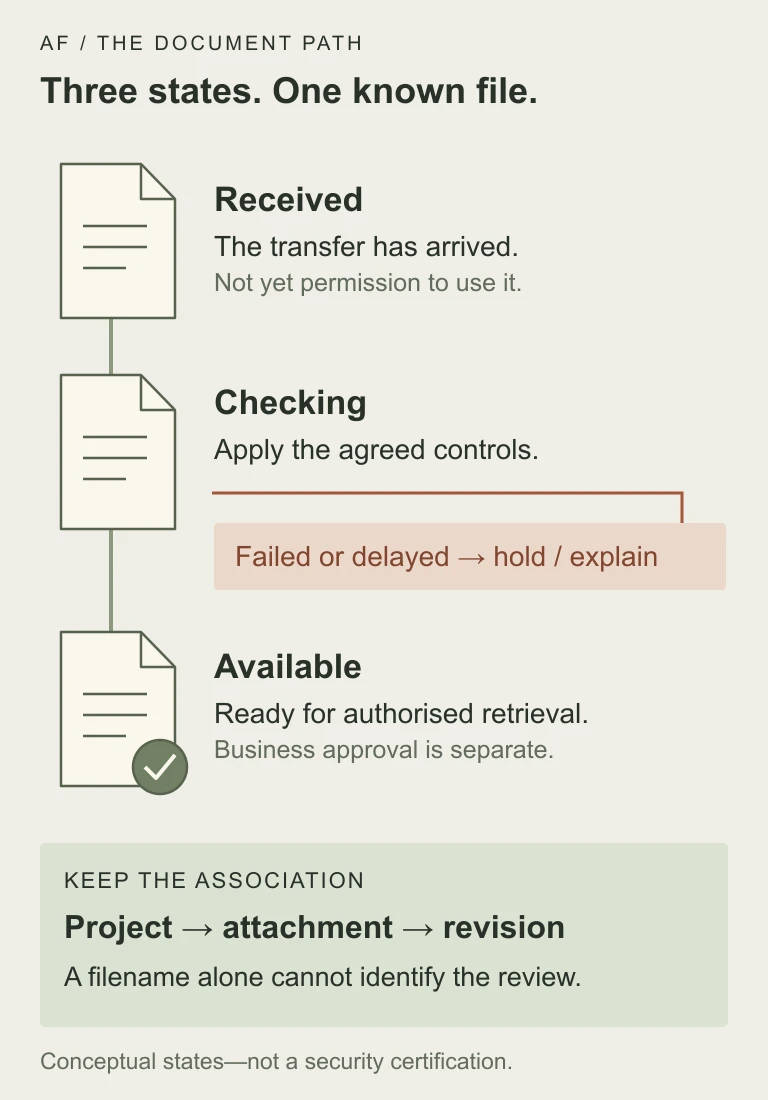
For the drawing portal, the interface might say ‘received—checking’, then ‘available for review’, or ‘not accepted—replace the file’. Those are proposed product states, not a required vocabulary or a completed implementation.
If scanning, conversion or preview generation is included, decide what is allowed while each step is pending. A preview failure might still allow an authorised original download under one policy; under another, it blocks the review. Make that an explicit decision rather than an accidental consequence of which background task finished first.
OWASP discusses antivirus or sandbox checking and, for suitable formats, content disarm and reconstruction. These are possible layers, not proof that a file is harmless. Ask who owns failed or unavailable checks, how held files are isolated, and what evidence releases them. Do not let a checker outage quietly become permission to bypass the agreed boundary.
Give the customer a way to return to the attachment and inspect its status. If the browser disconnects after receipt, recovering that known attachment is better than telling them to upload repeatedly without knowing what already exists.
04 / 06
Six decisions to put beside the estimate
This is Axiom Forge’s proposed attachment contract for a buyer and supplier to complete together. It is not a comprehensive security specification.
| Scope area | Decision to record | Evidence to request |
|---|---|---|
| Input envelope | Supported formats, size/count limits, volume and unsupported cases. | Allowed files work; a rejected file receives a useful explanation through the agreed checks. |
| Readiness | Which checks gate use, which previews are required, and what happens during an outage. | A pending or failed check cannot silently become available through another path. |
| Record and revision | The owning project, attachment identity and replacement/version rule. | Two identically named files remain distinguishable; the review points to the intended revision. |
| Access | Separate rights to upload, list, preview, download, replace and remove. | Another customer cannot retrieve an original, thumbnail or preview through a copied identifier. |
| Interruption | Retry, duplicate, cancellation and abandoned-transfer behaviour. | A disconnected session can discover the agreed result without unexplained extra attachments. |
| Lifecycle and ownership | Retention, removal, derived copies, exception owner and operational limits. | The documented cleanup and support route covers the original and relevant generated copies. |
Use synthetic documents and controlled accounts for acceptance. Include an interrupted transfer, a delayed check, an invalid input, a revised file with the same name and an unauthorised retrieval attempt. Agree safe samples with the engineering team; a buyer should not collect malware or upload real private documents to make a demonstration more convincing.
05 / 06
A filename is not a revision—and a private screen is not private storage
Give each attachment a stable identity, an owning record and a documented revision relationship. Preserve the original filename as useful display information where appropriate, but do not use ‘final.pdf’ as the only way to decide which drawing is current.
Replacement is a business choice. Should a new drawing supersede the old one immediately, or wait for review? Can reviewers finish comments against an older revision? Should the customer see that a previous document has been superseded? Our recommendation is to bind review decisions to an explicit revision rather than silently redirecting every old link to whichever file was uploaded last.
Apply the permission contract to originals and derived files. A hidden download button is not enough if a copied URL, preview or thumbnail is still accessible outside the intended customer boundary. Include those paths in the scoped review.
Storage mechanics can create surprises. For example, Amazon S3 documents presigned URLs as bearer access: possession can grant the permitted operation until expiry, and the URL can be reused during its validity. Uploading to the same object key replaces the existing object. Those are provider-specific behaviours to account for, not a recommendation to use S3 or a universal description of every storage service.
Ask how retrieval links are issued, protected and limited, and what a removed membership means for links already issued. Also distinguish expiring a link from deleting a file, and preventing future retrieval from recalling a copy somebody already downloaded.
06 / 06
Buy the morning after the upload too
Who can release a held document? Who helps a customer whose phone keeps losing connection? Who notices a growing processing queue? Those responsibilities belong in the handover, even if the first release needs only a modest upload volume.
Decide how abandoned files are cleaned up, how removal relates to the owning project, and which generated previews or extracted text must follow the same lifecycle. Agree any retention obligations with the responsible business and relevant advisers; do not invent a universal retention period from a storage setting.
A bounded proposal should separate interface work, storage and retrieval, checks and conversion, permissions, revision handling, operational visibility and handover. Adding resumable large transfers, many file types or downstream extraction changes that scope. Ask which capability is required now and which can remain a named exclusion.
For the drawing example, a complete first release might accept agreed document types, expose honest processing states, preserve explicit revisions and let authorised reviewers retrieve the intended file. It does not need an elaborate document-management suite to make those promises clear.
Axiom Forge can discuss document exchange as part of a scoped portal or business system. Send the workflow, supported file types, approximate volumes, user roles and required review outcome through the project brief or hello@axiomforge.am. Use synthetic or redacted examples; do not send credentials or private customer files in an initial enquiry.
Sources and editorial scope
This is Axiom Forge’s procurement and product-delivery guidance, not a guaranteed project plan. The example is illustrative. Sources checked on 23 Oct 2026.
- OWASP — File Upload Cheat Sheet — Defence-in-depth controls and storage/checking considerations; not a guarantee of file safety.
- MDN — HTML accept attribute — Browser file-selection hints do not replace server-side validation.
- AWS — Upload and download with presigned URLs — A concrete provider example of bearer access, reuse, expiry and same-key replacement; not a provider recommendation.