Enterprise software / Buyer’s guide
The Export Downloaded. Can Anyone Use It?
Scope an export that preserves records, relationships and attachments. A buyer’s guide to data boundaries, safe delivery and useful acceptance evidence.
The short answer
Specify what another person must be able to do with the export, not only which download button they can press. Agree the records and time boundary, field meanings, stable identifiers, relationships, attachments, exclusions and private delivery. Accept the feature by reconstructing a small known business case outside the original interface. A readable spreadsheet, a migration package and a recoverable backup are different deliverables.
Discuss your project ↗
Our take
Ask the supplier to close the application and explain one exported order from the files alone. Missing context becomes much easier to see when the original screen cannot silently supply it.
In this article
01 / 07
The orders arrived. Their meaning did not.
A service operator downloads the requested order export. Every row opens in a spreadsheet. The delivery team then asks a simple question: which drawing belongs to the second order line?
The file contains a customer name, a total and a filename. It does not identify the line items separately. Two attachments share that filename, and neither says whether it is the approved revision. The download worked; the intended handover did not.
This is an illustrative situation, not an Axiom Forge client incident. It exposes the question behind an apparently small feature: what should remain understandable when the software that displays the records is no longer present?
Start with the next reader. A finance colleague reconciling totals, an analyst exploring demand and a replacement system importing operational records need different exports. Naming that reader usually produces a more useful scope than asking for ‘all our data in CSV’.
02 / 07
A report, a handover and a backup make different promises
A reporting download can be deliberately flattened: one row per order, familiar labels and calculated totals. Its purpose is human inspection. An operational handover may need separate orders, customers, line items and attachment records linked by stable identifiers. It must preserve relationships that a report can reasonably hide.
A backup serves another purpose: restoring a defined service. An export can contribute to a recovery plan, but files that open successfully do not establish that the original system can be restored. Our backup and recovery guide addresses that separate requirement.
Axiom Forge recommends choosing the smallest package that supports the named next job. Do not make a one-off analysis carry the complexity of a complete migration. Equally, do not sell a summary report as an exit route from a business-critical platform.
Write an example deliverable into the brief: ‘An authorised operations owner can obtain the selected orders, their line items, referenced customers and agreed attachment revisions, together with a field dictionary and an explanation of exclusions.’ That sentence creates a boundary the supplier can estimate.
03 / 07
Export the relationships—not just the labels
Names are for people; identifiers connect records. If two customers share a name, another system should not have to guess which customer owns an order. Give each relevant record a stable identifier within the agreed export contract and retain the references between files.
The W3C model for tabular data and metadata provides a useful foundation: tables can carry metadata about columns and relationships rather than leaving meaning to the consuming application. You need not adopt its complete vocabulary to ask for a field dictionary, types and explicit links.
Define whether an empty value means unknown, not applicable or an intentionally blank string. Keep dates, time zones, currency and units interpretable. A column called ‘amount’ is incomplete if a reader cannot distinguish a displayed rounded figure from the stored amount and its currency.
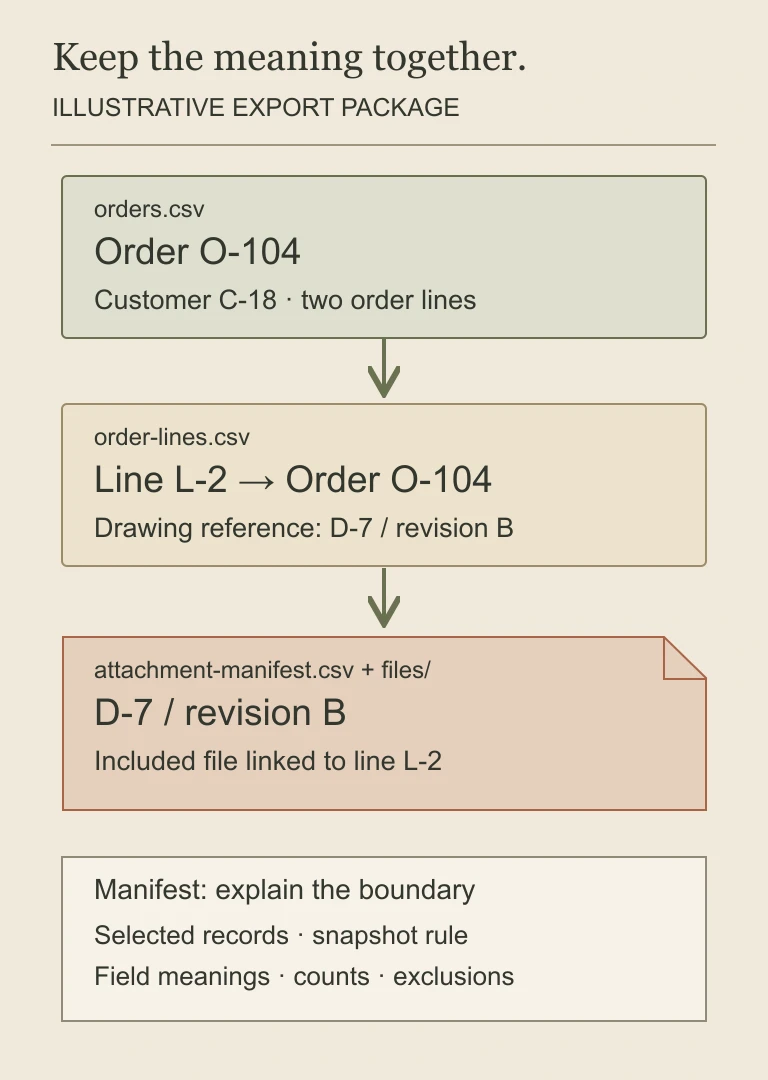
Attachments need their own contract. Agree whether the package contains original files, selected versions or only references. A download URL that expires before the handover is completed is not equivalent to an included file. A manifest should connect each expected attachment to its record and report any omission.
04 / 07
A long export needs one explainable moment
While the export runs, an operator changes a customer address and another colleague adds an order line. If different parts are read at different times, the finished package may combine states that never belonged together.
Agree what the product promises: a consistent snapshot, a bounded extraction with explicitly documented limitations, or a sequence of changes suitable for a downstream consumer. ‘Generated at 10:15’ does not, by itself, tell the reader when the underlying records were selected.
PostgreSQL’s transaction-isolation documentation illustrates why the distinction matters: its default Read Committed behaviour gives a query a snapshot, while separate queries can observe different committed states. That is a database-specific example, not a prescription for every export architecture.
For the buyer, the requirement is observable. Change a known record during a safe export rehearsal and ask the supplier to explain which version appears and why. Large packages may require additional engineering; do not assume that keeping a transaction open indefinitely is the appropriate design.
Record the selected filters, schema version, extraction boundary, record counts and exclusions alongside the files. Counts are useful reconciliation evidence, but matching counts alone cannot show that the right records and relationships arrived.
05 / 07
The file inherits the sensitivity of its contents
Export authority can be narrower than screen access. A colleague who can inspect one assigned customer should not automatically receive the whole customer table. Check both the selected records and fields, including records linked indirectly through attachments or related tables.
Agree who can request, retrieve and repeat an export, how long the generated copy is retained and what happens if the requester loses access before collecting it. Private storage and a comprehensible download policy belong in scope. An obscure filename is not an access control.
Spreadsheet convenience introduces another boundary. OWASP describes CSV formula injection: untrusted values can become executable formulas when opened in spreadsheet software. It also notes that there is no universal sanitisation method suitable for every spreadsheet and downstream consumer.
Do not silently corrupt the machine-readable source to make a human-facing download safer. If the uses need different handling, provide clearly distinguished outputs and document the transformation. Ask for evidence using representative formula-like text, leading zeros, commas, line breaks and non-Latin names—not only a file of ordinary surnames.
06 / 07
Five demonstrations before accepting Export
These are proposed acceptance scenarios for a safe preview environment. They are not tests performed on a customer system.
| Situation | Decision to agree | Evidence to request |
|---|---|---|
| Reconstruct one order | Which records, relationships and file revisions form the package? | A reader identifies the expected customer, each order line and the agreed drawing without opening the original app. |
| Change data during extraction | Which moment or change boundary does the export represent? | The result follows the documented rule; mixed-time limitations are visible rather than disguised. |
| Use a restricted account | Who may export each record and field? | The package contains no unauthorised neighbouring account, hidden field or attachment. |
| Interrupt and repeat | Does a retry retrieve the same job or start a new extraction? | The job identity, status, boundary and resulting files remain understandable; a partial file is not labelled complete. |
| Open and consume the files | Is the target a spreadsheet reader, an importer or both? | Types, identifiers and edge-case text survive the documented path, with spreadsheet hazards handled for that consumer. |
Require explicit handling of an empty selection, a missing attachment and a package too large for an immediate browser response. ‘No data matched’ and ‘the export failed’ are different messages. So are ‘ready to download’ and ‘downloaded successfully’.
The useful acceptance record contains the expected case, the resulting package and the explanation of differences. It is stronger evidence than a screen recording of a successful button click.
07 / 07
Buy an understandable exit—not a decorative button
Export has ongoing ownership. New fields, attachment types and relationship rules can leave an old package contract incomplete even while the download continues to run. Agree who maintains its version and who tells downstream users about a breaking change.
Keep the scope distinct from import processing, which decides what incoming rows are allowed to change, and source-code ownership, which concerns delivery assets and rights. Controlling the code does not automatically produce a useful business-data export.
When commissioning a portal or business system, bring one record that must remain meaningful after leaving it. Describe the next reader, expected files and exclusions in the project brief, or email hello@axiomforge.am. That gives the supplier a concrete deliverable—and gives you something real to accept.
Sources and editorial scope
This is Axiom Forge’s procurement and product-delivery guidance, not a guaranteed project plan. The example is illustrative. Sources checked on 5 Nov 2026.
- W3C — Model for Tabular Data and Metadata on the Web — Primary model for tabular data and associated metadata. The recommended commercial export package is Axiom Forge guidance, not a claim that adopting this specification alone establishes portability.
- PostgreSQL — Transaction Isolation — Primary example of query snapshots and isolation boundaries. Behaviour is PostgreSQL-specific; the article does not prescribe an implementation for every database.
- OWASP — CSV Injection — Primary security guidance on spreadsheet formula handling and consumer-specific mitigation limits. No universal escaping recipe is promised.