Web Platforms / Buyer’s guide
A Fast Website Is More Than a Green Score
Commission speed your visitors can use. Define a website performance budget, lab conditions, real-user evidence and ownership after launch.
The short answer
Agree the pages, journeys and conditions before agreeing a score. Use a resource budget and repeatable lab checks during development, then review real-user experience when sufficient data is available. Verify that important actions actually work. Include production content, consent states and third-party widgets in the agreed scope, and assign ownership for later changes. A green laboratory result is useful evidence—not a universal customer-experience or ranking guarantee.
Discuss your project ↗
Our take
Buy a performance promise the team can explain and reproduce. The meaningful question is whether visitors can see the offer, use the interface and finish the intended task under the conditions that matter to your business.
In this article
01 / 07
The report looks reassuring. The booking panel still feels slow.
Imagine a redesigned business website presented with a green laboratory report. On a visitor’s phone, the offer appears, but opening the booking panel feels sluggish and a late element moves the page just as they tap. The report and the experience can both be real without describing the same conditions.
This is an illustrative scenario, not an Axiom Forge client incident or a claim about a particular website. The purchasing lesson is to define what was evaluated: which page, which content, which device and which part of the journey.
A performance score is useful for investigation and comparison under controlled conditions. It is not a substitute for the full commercial promise. Your buyer still needs to understand the offer, select a service and reach a confirmed outcome. A fast decorative first screen does not establish that the rest works well.
Ask for that evidence before agreeing the launch gate. Otherwise ‘fast website’ can quietly mean ‘one favourable run of the homepage’, while the enquiry page and the tools it depends on remain outside the discussion.
02 / 07
Keep the laboratory, real visitors and the task in separate view
Google’s explanation of lab and field data distinguishes controlled measurements from visits on real devices and networks. Lab checks help reproduce a problem. Field observations reflect the varied conditions of an eligible observed audience. They need not return the same number.
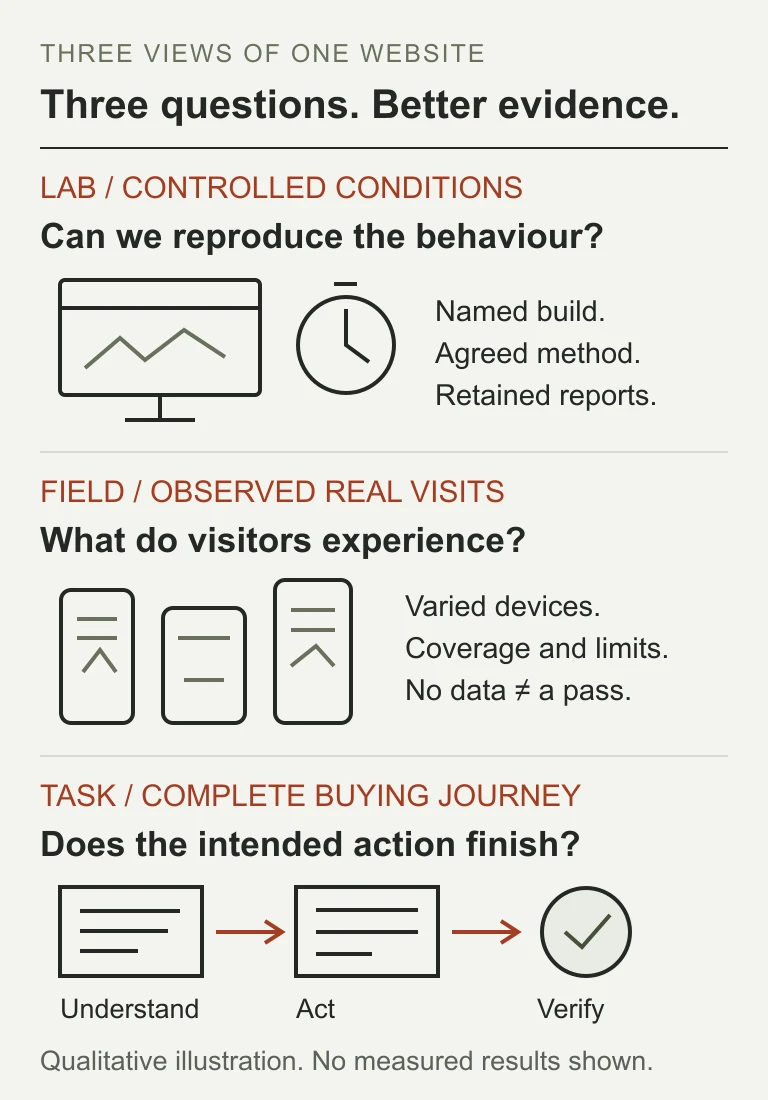
Axiom Forge adds a third buying question: does the agreed task finish correctly? A responsive button is not proof that a booking service accepted the request. Equally, a correct submission says little about how long the page took to become usable. Keep operational correctness and performance connected, but do not label one as the other.
Ask the supplier to retain the source of each result rather than flatten everything into a badge. A lab finding, a field distribution and an end-to-end demonstration should say what they cover and what they leave unknown.
For example, the Chrome UX Report methodology has eligibility and sample requirements. A new or lightly visited page may lack reportable field data. ‘No data’ is not evidence that it passed; it calls for an honest limitation and a plan for later observation. Do not present origin-wide evidence as a measured result for an unreported individual page.
03 / 07
Write a performance brief another team could reproduce
The matrix below is Axiom Forge’s commissioning framework. It connects a performance promise to its conditions and owner. It is not a universal service-level agreement or a claim that every website requires the same numeric limits.
| Decision | Specify in the brief | Evidence to retain |
|---|---|---|
| Pages and states | Representative templates, real content, languages, consent states and key journeys. | Named URLs, included dependencies and exclusions. |
| Lab conditions | Tool/version, device profile, network, cache state and repeat-run method. | Reports tied to the evaluated build and conditions. |
| Resource budget | Agreed limits for images, scripts, fonts and important third-party resources. | Build or page checks with a clear over-budget response. |
| Experience measures | Relevant field metrics, audience segmentation and review window. | Available distributions, coverage limits and unresolved findings. |
| Ongoing ownership | Who checks new media, tags, widgets and template changes. | Change-review process and an accountable correction owner. |
Review a service page and its enquiry path, not only the homepage. If an editor can publish new content, include a realistic content-heavy example. If visitors choose a language, evaluate representative translated content rather than assume the original layout and asset pack cover it.
Compare candidates under the agreed method. Repeated lab runs help reveal variation; choosing only the best-looking report hides it. Record a material exception as an exception, with its impact and decision owner, instead of silently changing the conditions to obtain a pass.
04 / 07
Use Core Web Vitals with their measurement boundary intact
The current Core Web Vitals guidance covers loading, responsiveness and visual stability. Its good thresholds are useful reference points, but they are not a guarantee that every visitor or business operation meets a universal deadline.
| Measure | Experience dimension | Good threshold |
|---|---|---|
| LCP | Largest Contentful Paint: loading. | 2.5 seconds or less. |
| INP | Interaction to Next Paint: responsiveness. | 200 milliseconds or less. |
| CLS | Cumulative Layout Shift: visual stability. | 0.1 or less; a unitless score. |
The guidance assesses the 75th percentile, segmented across mobile and desktop, for all three metrics. It does not say every visit must achieve the same value. Retain that statistical meaning when putting a target into an acceptance record.
A page-load-only Lighthouse run has no real user interaction and does not measure INP. Total Blocking Time can support lab diagnosis; it is not the same metric. Ask for the relevant interactive review and field evidence instead of describing a load score as complete responsiveness proof.
Google recommends good Core Web Vitals as part of page experience. Axiom Forge does not turn that recommendation into a promised ranking, conversion lift or lead volume. Those outcomes require separate evidence and depend on more than performance.
05 / 07
A budget should protect the story, not erase it
A performance budget makes additions reviewable. The web.dev budgeting guide describes limits on resources and experience-related measures. The enduring idea is to connect a design or technology choice to a measurable constraint—not to copy an old example’s device assumptions or default byte allowance.
Axiom Forge recommends setting limits from the page’s purpose and evaluated audience, then reviewing the trade-offs with the designer and engineer together. A product demonstration may earn its media cost. An autoplay flourish that delays the offer may not. Neither ‘all animation is bad’ nor ‘premium means heavier’ is a useful rule.
Give the supplier realistic assets early. Ask how images will adapt to viewport size, how their geometry is reserved and how fonts and motion behave under the agreed conditions. Treat the primary message and action as first-class content rather than something visitors must wait to uncover.
Resource limits alone are insufficient. Two similarly sized pages can behave differently because of what they request, execute and reveal first. Pair the asset budget with the experience checks. When an addition exceeds the agreement, decide whether to optimise it, simplify another part or accept a documented exception—not merely raise the limit without review.
06 / 07
The booking widget changes the page you actually launch
Return to the fictional redesign. Suppose the staging candidate uses a lightweight placeholder, while the released page includes a booking widget and marketing tags. The content may look almost identical, but the evaluated dependency set is different. The earlier report cannot establish the performance of the later configuration.
A useful review starts by comparing the evaluated and deployed versions: content, widget settings, consent state, scripts and cache assumptions. Then run the agreed checks on the real included journey. Do not disable an essential widget for the audit and describe that result as the complete customer experience.
The options are commercial as well as technical. The team might defer nonessential code, replace a dependency, simplify the interaction or keep the required component with an explicit limitation. If booking is moved to another page, evaluate that route too. Moving the cost out of the homepage report does not eliminate it from the visitor’s task.
Assign ownership. The studio may control the site but not the vendor’s implementation; marketing may add tags after launch. The proposal should name who can change each dependency, who monitors its effect and what happens when it becomes unavailable. A supplier cannot responsibly promise perpetual behaviour for components nobody in the engagement controls.
07 / 07
Make launch a measured beginning, not the last screenshot
A pre-release gate can use agreed lab checks, resource budgets and working journeys. Field verification needs real visits and adequate coverage. Agree the post-launch review window, evidence source and correction responsibility without pretending that a new page already has a trustworthy population of observations.
Monitoring is itself a scoped feature. Decide what will be collected, how pages and device groups are identified, who may access the results and how privacy and consent obligations are handled for the actual markets. Avoid putting customer records, form contents or unnecessary identifiers into performance telemetry.
Keep the review connected to publishing. A new campaign image, font, embed or tag can change a previously evaluated page. Give editors practical asset guidance and an escalation route. The CMS buying guide helps define that publishing work; the accessibility guide addresses related interaction requirements without treating speed as a substitute for access.
Ask proposals to itemise investigation, agreed optimisation, monitoring, third-party work and future maintenance alongside the website investment. Existing-site work needs a baseline and dependency review before a credible estimate. There is no universal ‘speed fix’ price or completion date in this guide.
For a private discussion with our website development team, send public URLs, priority journeys, audience conditions and a list of required widgets. Use the project brief or hello@axiomforge.am. Please omit passwords, private analytics exports and customer data. We can discuss a reviewable performance scope and the evidence needed to accept it.
Sources and editorial scope
This is Axiom Forge’s procurement and product-delivery guidance, not a guaranteed project plan. The example is illustrative. Sources checked on 13 Oct 2026.
- web.dev — Web Vitals — Current LCP, INP and CLS reference thresholds and measurement boundaries; no universal visitor or business-result guarantee.
- web.dev — Why lab and field data can be different — Controlled checks and observed real-user distributions describe different conditions.
- Chrome for Developers — CrUX methodology — Eligibility, sample and page/origin coverage limits; missing data is not an observed pass.
- web.dev — Performance budgets 101 — Resource and experience budgeting concept; older TTI, device and byte examples are not adopted as current defaults.
- Google Search Central — Core Web Vitals — Page-experience guidance, not a guaranteed search position or commercial result.