Mobile applications / Buyer’s guide
The Message Was Sent. Is It Still the Right Message?
Scope notifications around the right person, current information and a useful next action—not just a successful send. A buyer’s guide for apps and portals.
The short answer
A notification needs a contract: who should receive it, which business state it describes, how long it remains useful, which channel evidence is available and what the person should do next. Agree what happens when it becomes obsolete or contact fails. A successful send is not proof of receipt, understanding or action.
Discuss your project ↗
Our take
Commission the complete communication loop. A beautifully written message can still be wrong for the person, the moment or the state of the order.
In this article
01 / 06
The order is on hold. The phone says it is ready.
Imagine an illustrative collection service. An order becomes ready, so the application schedules a pickup alert. Before the customer receives it, a staff member discovers a problem and puts the order on hold. The customer’s phone reconnects later and displays the cheerful original message.
The notification system may have done exactly what its brief requested: send a message when an order becomes ready. The customer still receives the wrong instruction.
That gap is why ‘email and push notifications included’ is not yet a useful scope. The real feature is timely communication about a changing business process. The first design question is what the person needs to know or do—not how many channels the application can connect.
Start with one important event and follow it through the waiting period, the destination screen and the failed-contact path. A small, complete communication loop is easier to understand than a catalogue of templates with no operating rules.
02 / 06
Write the sentence behind the template
For our collection service, a useful requirement could read: ‘Notify the current collection contact that this order is ready, while collection remains possible, and take them to its current collection instructions.’ That sentence exposes decisions which a template cannot make.
Who is the current contact: the buyer, the person collecting, or an account administrator? Which language and time zone belong to that person? Should the system notify every registered device, one preferred channel, or an in-app inbox plus an external alert? If responsibility changes while a message waits, do you re-evaluate the recipient or preserve the original recipient for a particular reason?
Give each notification class its own purpose. An invitation that expires, a reminder about a current task and a receipt documenting a past event do not have the same useful lifetime. Suppressing an obsolete ‘ready now’ alert may be appropriate; silently erasing a historical cancellation receipt may not be.
These are Axiom Forge product recommendations, not a rule that every message should behave identically. Keep marketing messages separate from service notifications, and agree applicable consent, preference and delivery policies with the responsible owner. Calling a message ‘transactional’ is not blanket permission to ignore those decisions.
03 / 06
Accepted, delivered and acted on are different observations
A status label should say only what the system actually knows. In Twilio SendGrid’s event reference, ‘processed’ means the provider accepted the email; ‘delivered’ means delivery to the receiving server succeeded. Neither establishes that a person read it. The reference also identifies machine-generated open signals, another reason not to treat an open event as an acknowledgement.
The same boundary matters for push. Firebase’s message-lifespan documentation says a returned message ID establishes acceptance for delivery, not arrival on the device. It also provides expiry controls for messages that cannot be delivered immediately. A useful business deadline therefore needs an explicit delivery policy, not an assumption that every queued alert remains valuable indefinitely.
In the product, keep those observations separate from the next business action. ‘Provider accepted’, ‘delivery reported’ and ‘customer confirmed collection’ should not collapse into one reassuring green ‘done’ badge. Where acknowledgement matters, design an explicit action with an accountable record.
This does not mean every product needs invasive message tracking. Choose the minimum evidence necessary for the workflow, explain its limits to support staff and avoid copying message bodies or personal data into unnecessary analytics streams.
04 / 06
Give an unsent message a chance to become unnecessary
For current-state alerts, check the relevant state and recipient at the agreed point before dispatch. Define how pending work is cancelled, replaced or allowed to expire. Where the provider supports expiry or replacement, configure it for the message’s purpose and verify the actual behaviour on the supported platforms.
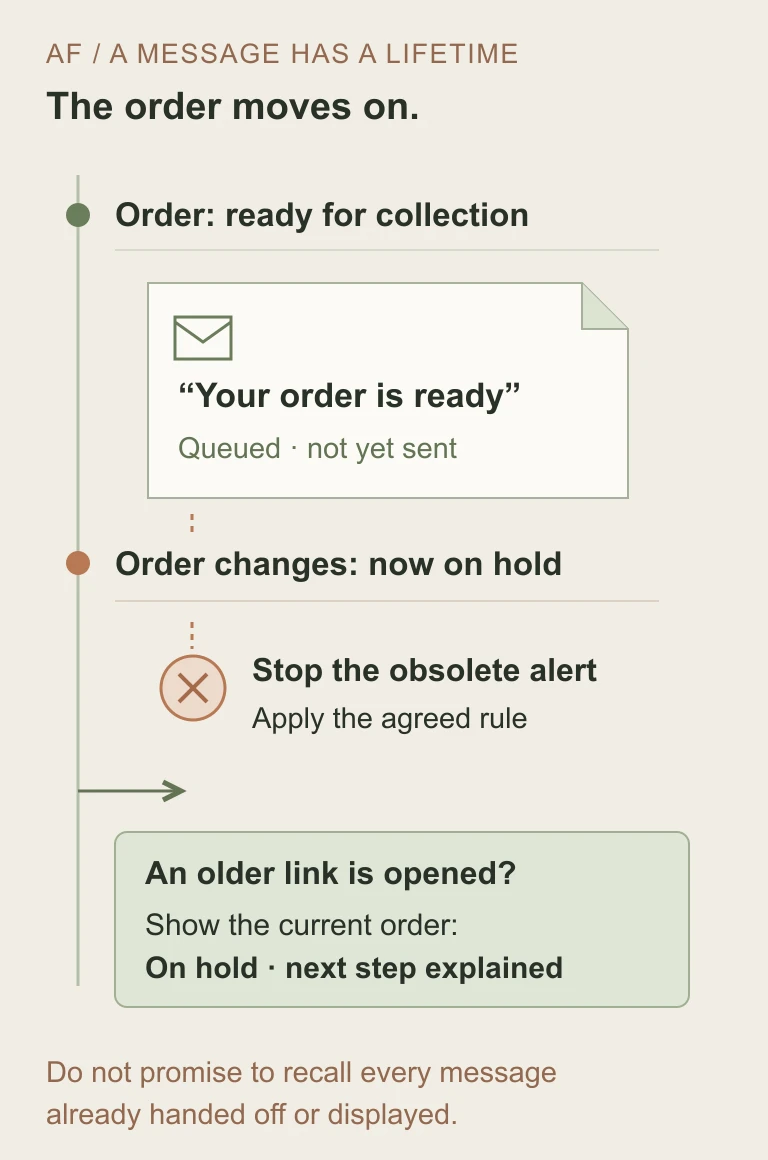
Do not promise that every message already handed off or displayed can be recalled. Instead, make its destination honest: when a customer opens an older alert, show the order’s current state and explain any relevant change. Avoid a dead-end instruction that remains actionable only because its text was generated earlier.
The webhook integration guide covers delivery retries and duplicate effects. Here, the separate product decision is whether the message should still exist at all. The audit-trail guide covers the historical record; do not use an inbox as its substitute.
05 / 06
Five demonstrations reveal more than a successful test send
Agree these outcomes with the supplier using known records and a safe preview or test environment. They are proposed acceptance examples, not tests performed on a customer’s system.
| Situation | Decision to agree | Evidence to request |
|---|---|---|
| Order changes | The order goes on hold before a ready alert leaves the queue. | The obsolete alert is suppressed or replaced under the agreed rule, with an explained outcome. |
| Person changes | The collection contact changes while notification work waits. | The intended recipient and authorisation rule are applied; unrelated account members receive nothing. |
| Time runs out | The phone reconnects after the alert’s useful deadline. | The supported channel’s expiry behaviour is demonstrated; the app still exposes the current order. |
| Contact fails | The email bounces or the push destination is no longer valid. | Support sees the bounded failure and the next owner; retries or fallback follow the contact policy. |
| Person acts | The customer opens an older link and confirms an allowed next step. | Current permissions and order state are checked; delivery evidence stays separate from the confirmed action. |
Include a duplicate and a slow response where the workflow needs them, but do not let the demonstration become a transport-only exercise. The important result is that the right person receives a useful, truthful route to the next action.
06 / 06
Keep the important information behind a usable, safe next step
A lock-screen preview, shared mailbox or forwarded email may reach more people than the signed-in product. Decide how much detail belongs outside the application. A neutral ‘Your order has an update’ may suit some workflows; others need a clear time and location. Make that a deliberate privacy-and-usability choice, not the accidental contents of a database template.
The destination should remain understandable after a session expires. Preserve the intended destination through an appropriate sign-in flow, then check the current person’s permission before revealing the record or accepting a change. A copied link should not become authority to view someone else’s order. If the destination is unavailable, give the customer a comprehensible route back or to support.
Finally, name who notices missed or delayed notifications, who owns templates and translations, and who handles provider or sender-configuration problems. Automatic fallback to SMS or another address can create cost and privacy consequences; it needs a contact policy, not an unlimited retry rule.
For a mobile app or customer portal, bring one event, one intended recipient and one desired next action to the project brief, or email hello@axiomforge.am. That is enough to start defining a communication feature the business can actually accept and operate.
Sources and editorial scope
This is Axiom Forge’s procurement and product-delivery guidance, not a guaranteed project plan. The example is illustrative. Sources checked on 25 Oct 2026.
- Twilio SendGrid — Event Webhook Reference — Primary definitions of provider processing, receiving-server delivery and machine-open signals. These are channel observations, not proof of human acknowledgement.
- Firebase Cloud Messaging — Set the lifespan of a message — Primary guidance on acceptance versus device delivery and message expiry. The article’s collection workflow is illustrative, not a provider guarantee.