Enterprise software / Buyer’s guide
The Record Changed. Can You Explain What Happened?
A useful audit trail explains a business change, not just a button click. Define the evidence, privacy boundaries and recovery behaviour before commissioning it.
The short answer
Specify the questions the history must answer: which record changed, what changed, who or what caused it, whether it succeeded, and which evidence supports that account. Then agree coverage, restricted access, retention and what happens when capture fails. A visible activity feed alone does not settle those decisions.
Discuss your project ↗
Our take
Buy an explainable record of business events—not a long list of technical messages that someone must interpret after a dispute.
In this article
01 / 06
The job belongs to a different team. Nobody remembers moving it.
Consider an illustrative work-order system. A maintenance job was assigned to the north team yesterday. This morning, the south team sees it in its queue. The current record is perfectly clear. The reason for the change is not.
Did a dispatcher reassign it? Did an overnight rule move it when the first team became unavailable? Was an earlier update replayed? An activity line saying ‘Job updated’ leaves all three explanations open.
This is the moment to define an audit trail as a product feature. Someone needs to answer a real operating question without reconstructing the day from chat messages and server logs. Start with that question, rather than asking the development team to ‘log everything’.
For a first release, choose the changes that matter most: assignment, priority, status, cancellation and changes to the rules that govern them. Broader coverage can follow a deliberate plan. An unspecified claim that every action is recorded is harder to accept than a named set of events with demonstrated coverage.
02 / 06
A feed, a debugging log and a business history serve different readers
A friendly feed might say ‘Moved to the south team’ and help staff understand the next action. Diagnostic logs help engineers investigate a failed request. The business history needs enough stable context to explain a particular change later. None automatically substitutes for the others, or for a formal financial ledger.
OWASP’s logging guidance distinguishes audit and process records from security logging and recommends recording sufficient context about the event, actor, action and result. It also warns against placing secrets and sensitive information directly in logs. Those are useful foundations; the business still has to decide what its own history must explain.
Axiom Forge’s recommendation is to make a small event receipt the shared starting point. For the work order, that could identify job WO-218, its organisation, the assignment change, the previous and resulting team, the initiating account, the committed revision, the outcome and the applicable event time. If an automation acted, name that service and the relevant rule revision instead of attributing the change to a vague ‘system’.
Where someone legitimately acts on another person’s behalf, preserve both identities and the delegation context. Do not infer the actor solely from a mutable display name. Decide what should remain understandable when the person changes their name or leaves the organisation, without retaining unnecessary profile data.
03 / 06
Follow the saved change—not merely the click
The browser can report that a person pressed Save even when the server refused the update. Conversely, an automated change can happen with no browser involved. Put the business event at the authoritative change boundary and state whether it describes an attempt, a committed change or a later processing result.
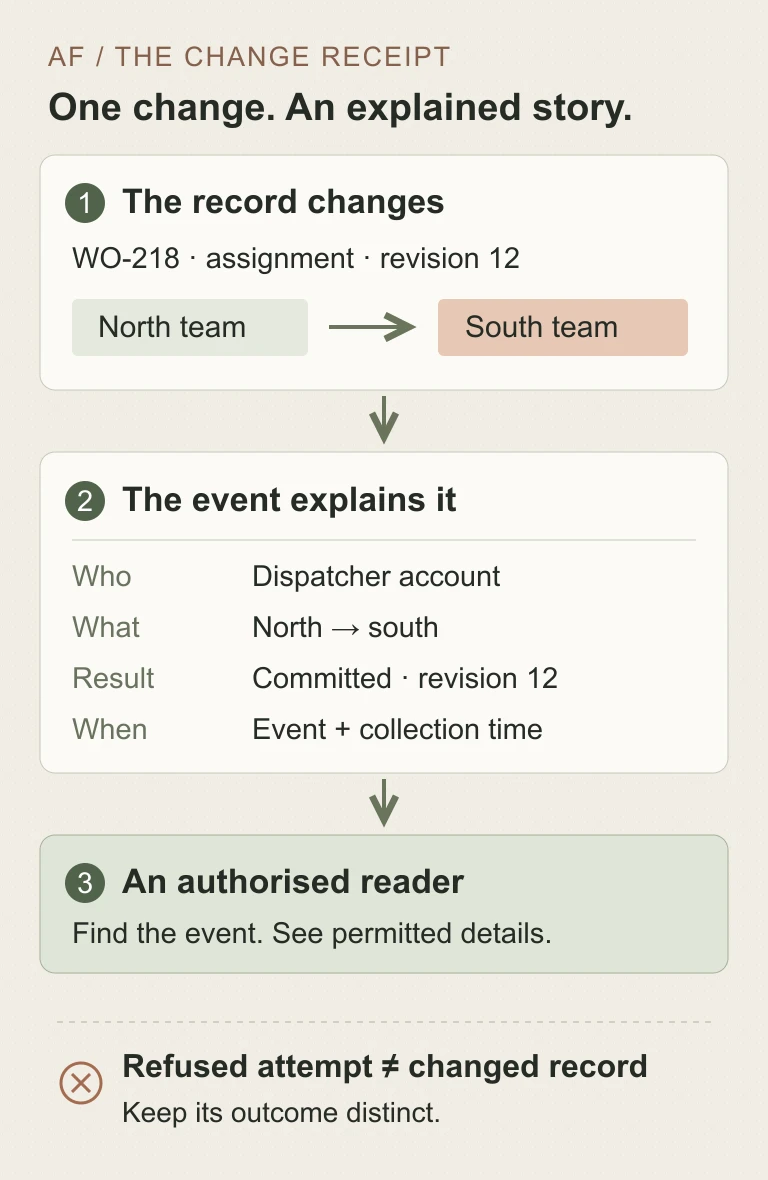
Ask how the design prevents a saved change from silently losing its history entry. Depending on the workflow, the answer may involve capturing both within one transaction, or durable capture with a visible pending state and recovery procedure. The buyer’s decision is what must happen if that guarantee cannot be met: reject the consequential change, defer it, or allow a clearly monitored gap. Do not let an accidental error-handler choice decide the policy.
Also separate event identity from delivery identity. Retrying delivery of the same event should not make the history suggest that the job was reassigned three times. A genuinely new reassignment needs its own event, even if it happens to restore an earlier value. The webhook commissioning guide explores that transport boundary in more detail.
04 / 06
Six moments worth demonstrating before acceptance
A convincing demonstration begins with known records and expected outcomes in a safe environment. The following is a proposed acceptance set, not a report of tests we have performed on a client system.
| Moment | What the history should explain | What to inspect |
|---|---|---|
| Saved change | A named dispatcher moved WO-218 from north to south. | Committed revision, permitted before/after fields, actor and outcome match the record. |
| Refused attempt | A person tried to change priority but lacked authority. | No changed business revision; a separately classified refusal is available to the authorised reviewer. |
| Rule-driven move | A service reassigned a job under a named rule revision. | Service identity and rule context survive; a delivery retry does not invent another move. |
| Late arrival | A captured event reached the history reader after a collection delay. | Event and collection times remain distinguishable; lateness is not silently presented as a later business change. |
| Correction | An authorised person reversed the mistaken assignment. | A new correction references the earlier event instead of making the original account disappear. |
| History access | A reviewer searched or exported the permitted history. | Organisation boundaries, field masking, export rules and agreed access-event coverage hold. |
Order needs a little care. OpenTelemetry’s log data model distinguishes the time an event occurred from the time a collection system observed it. That distinction is useful here, but timestamps alone do not establish the order of conflicting business edits. Ask for the record revision or another ordering rule appropriate to the system, and an explicit treatment of uncertain device clocks.
05 / 06
More detail is not always better evidence
A complete database snapshot can make a history implementation look thorough while copying private notes, tokens or unrelated personal details into a second system. Prefer a field-by-field decision: what must be understood, what may be displayed, what needs masking, and what should never enter the history at all.
For our work-order example, a change from north team to south team may be enough. Repeating a customer’s home access instructions in every revision is a different—and usually much harder to justify—decision. History readers and exports need their own permission boundaries; permission to edit a work order does not automatically mean permission to read every past value. See the business permission contract for the surrounding access model.
Decide who can alter the capture settings, repair a failed pipeline and authorise disposal. A tamper-evident or append-oriented design can be useful, but neither phrase makes the evidence independently trustworthy. Ask which privileged actors could change it, what would reveal interference and which copies or exports remain outside that control.
Do not turn ‘preserve the original event’ into ‘keep everything forever’. Retention, deletion obligations, contractual needs and investigation holds depend on the organisation and applicable requirements. Agree that policy with the responsible people, then document how authorised disposal differs from an unrecorded rewrite. This guide is not a legal or compliance certification.
06 / 06
Commission the person who notices a missing chapter
A history page can render normally while an overnight job has stopped capturing events. Its clean appearance says little about completeness. Ask who watches capture failures, unusual delays and the gap between expected business changes and recorded events, and how they investigate without exposing the underlying sensitive data.
Include recovery in the scope: which events can be reconstructed, how reconstructed entries are labelled, and which gaps cannot be repaired honestly. After a restore, the business record and its history must have an explained relationship; the backup and recovery guide covers that wider operating decision. Never invent a convincing historical entry to fill an unknown interval.
A useful first brief can be short: one workflow, the important events, the questions each receipt answers, permitted readers, retention ownership, failure policy and the demonstrations above. Request the event catalogue and its coverage record alongside the screen and export—not as undocumented engineering knowledge.
If you are commissioning a business system or client portal, send that workflow through the project brief or write to hello@axiomforge.am. The first decision is which changes the business must be able to explain, not which logging platform has the longest feature list.
Sources and editorial scope
This is Axiom Forge’s procurement and product-delivery guidance, not a guaranteed project plan. The example is illustrative. Sources checked on 24 Oct 2026.
- OWASP — Logging Cheat Sheet — Primary guidance on application event context, distinct logging purposes, sensitive-data exclusions and protection. It does not define this article’s proposed work-order contract.
- OpenTelemetry — Logs Data Model — Primary definitions of event Timestamp and ObservedTimestamp; telemetry fields do not themselves prove business-event completeness.