AI & automation / Buyer’s guide
Mistral Large 4 Is Open. Is Your Coding Agent Portable?
Mistral’s October 29 open-weight release adds deployment choice. Examine the adapters, tool contracts and evidence needed to move a coding assistant.
The short answer
Mistral’s October 29 release of improved Large 4 open weights creates a new deployment option beyond its earlier API preview. It does not make an existing coding agent interchangeable across backends. Evaluate the model adapter, message format, reasoning configuration, tool calls, context assembly and operating evidence as one system. Keep permissions, sandboxing and release approval outside the replaceable model. This is a documentary analysis, not a hands-on benchmark or deployment report.
Discuss your project ↗
Our take
A credible portability promise should survive one carefully observed backend change. Ask what must stay compatible and what evidence is required—not whether two endpoints both accept a chat request.
In this article
01 / 06
The assistant still answers. The workflow no longer finishes.
Imagine an internal coding assistant asked to prepare a small change to a document-upload form. It reads a disposable repository, edits within a named folder and returns a patch for an engineer to review. The company wants the option to move inference from a hosted service to its own deployment.
The replacement endpoint produces plausible text. But its tool arguments are handled differently, a context-building assumption changes, or the assistant stops before producing the expected patch. The integration is reachable; the commissioned workflow is not yet portable.
This is an illustrative commissioning scenario, not a test we performed. It is a useful lens for Mistral Large 4 because open weights change where a model can be operated, while leaving the surrounding product contract to the team building the agent.
The buyer’s question is therefore narrower than ‘Can we self-host it?’ It is: ‘Can another inference backend complete our agreed task inside the same operating boundary, and can we explain the differences?’
02 / 06
October 6 was the preview. October 29 changed the deployment choice.
Mistral introduced Large 4 as an API public preview on October 6, 2026. Its October 29 announcement released improved model weights after additional reinforcement learning and introduced three reasoning modes: low, medium and high. High is the default. That is the recent event examined here; this is not a claim that the model launched today.
The official model card provides deployment guidance and describes text-and-image inputs, text output, function calling and structured output. The current model documentation, checked on November 5, still labels the API model Public Preview. However, Mistral’s lifecycle register marks the October 6 preview retired and the October 29 version active. These official pages are not fully aligned. Verify the exact endpoint and checkpoint offered to your account rather than treating a documentation badge as a complete availability statement.
The release also generated a substantial Hacker News discussion linked from October 29. That establishes independent attention, not proof of capability or business value. This article uses Mistral’s own material for product claims and does not rely on commenters’ benchmark or pricing comparisons.
For a product buyer, the meaningful change is the additional operating choice. It warrants a bounded evaluation if inference location or backend dependency matters to the product. It does not, by itself, justify replacing an agent that already meets the business requirement.
03 / 06
The model is only one moving part
A coding agent includes instructions, context selection, tools, execution limits, credentials, a workspace and a record of its work. A shared API shape can make transport easier without preserving every behavioural assumption.
Axiom Forge recommends writing the portable boundary before selecting the replacement. The model adapter may need to translate message structures, handle reasoning configuration, validate tool arguments and map completion or failure states. The harness decides what repository material to send, which tool may run and when to stop. Those responsibilities should not be hidden inside a claim that the endpoint is compatible.
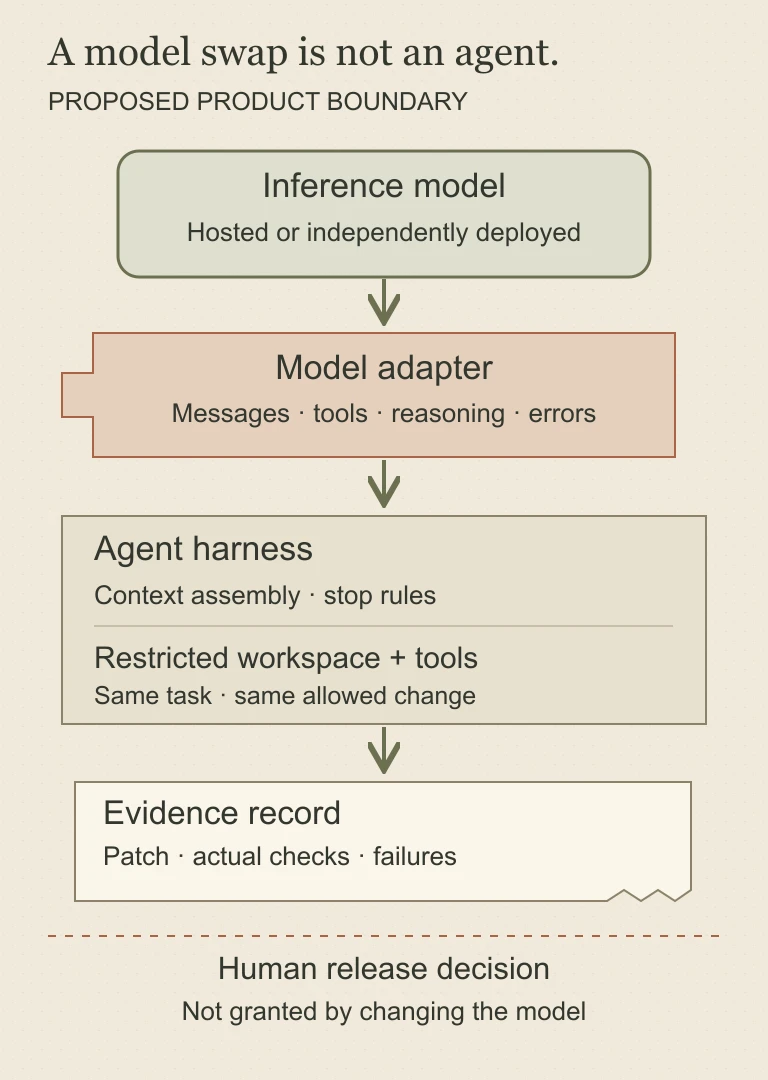
For the upload-form example, keep the task statement and allowed files stable. Record the exact model or deployment revision available to the team, adapter version, reasoning choice, input context policy and tool definitions. Then inspect whether the assistant asked for the right operation and whether the harness interpreted it correctly.
Do not demand identical prose or identical intermediate steps. Demand the same business boundary and enough evidence to explain whether the resulting change is acceptable.
04 / 06
What the release offers—and what remains yours to prove
| Documented option | Potential use | Not established by the announcement |
|---|---|---|
| Downloadable weights | Consider an independently operated inference deployment. | Your hardware fit, capacity, isolation, operating cost or licence suitability. |
| Three reasoning modes | Evaluate different effort settings for bounded maintenance tasks. | Which mode meets your quality and response-time requirements. |
| Function calling and structured output | Connect a model response to a defined agent-tool contract. | Compatibility with every existing tool schema or safe execution of requested actions. |
| Text and image input | Evaluate tasks that include repository text and interface references. | Correct interpretation of your screenshots, private codebase or acceptance criteria. |
| Published coding results | Identify tasks worth evaluating. | A delivery-time saving, mergeable patch or production outcome in your own product. |
The distinction matters commercially. A proposal can legitimately include investigating deployment feasibility without promising a completed private installation. It can include an evaluation without promising that the candidate will beat the incumbent. Price those decisions separately from the production integration.
We have not run Large 4 or compared its modes. No claim here establishes faster delivery, lower total cost, stronger security or equivalence with another model.
05 / 06
Buy one provider-change rehearsal before a migration programme
Use a disposable copy of an authorised repository and representative non-sensitive fixtures. Give both configurations the same bounded outcome: for example, prepare an upload-form change, keep file validation on the agreed server path and leave unrelated files untouched. Define what a reviewer must inspect before accepting the result.
Compare the completed work and the operating record: selected files, proposed tool calls, validated arguments, actual tool outcomes, patch scope and checks that were or were not performed. An assistant that describes a check is not evidence that the check ran. A transport failure and a rejected tool request should not both become a generic model error.
Include at least one awkward continuation. If a tool returns an error, can the system report it honestly? If the change cannot be completed inside the file boundary, does it stop and explain rather than widen its own access? These are proposed evaluation cases, not observations about Large 4’s behaviour.
Measure resource use and elapsed time for the complete attempted task, including failed attempts and review work. A per-token rate or vendor benchmark is not the price of an accepted change. Keep confidential repository data out of an unapproved endpoint while comparing options.
The AI acceptance guide covers broader release evidence. This rehearsal adds a particular requirement: retain enough of the old configuration and run record to distinguish a model change from an adapter or tool-contract regression.
06 / 06
Open weights do not finish the operating agreement
Before adoption, check the exact licence for the chosen checkpoint, the intended service and any redistribution or hosting arrangement. The official model card identifies the Mistral Ecosystem Open-Weight License and says a Model-as-a-Service business requires a separate commercial licence. Do not replace that review with the phrase ‘open source’. Also verify the current API lifecycle, account access and any regional processing requirement that matters to the organisation.
For self-hosting, ask for evidence of the chosen runtime, hardware, supported configuration, capacity and update process. For a hosted API, ask how failures, limits and model changes affect the agent. This article does not assert that either route is available in every region or commercially suitable for every deployment.
Permissions should remain explicit on both paths. Changing the inference engine must not automatically grant broader shell access, production credentials or permission to release a patch. The agent-team release-authority analysis addresses that separate decision.
The right first engagement is often small: one representative task, two documented backend configurations and a clear decision to retain, adapt or reject the candidate. If the existing system already works and deployment choice has little value, doing nothing may be the better outcome.
For an AI-assisted business workflow, describe the task, repository sensitivity, operating boundary and reason for wanting another backend in the project brief, or email hello@axiomforge.am. Commission the freedom you actually need—not an untested promise that the engine can be swapped.
Sources and editorial scope
This is Axiom Forge’s procurement and product-delivery guidance, not a guaranteed project plan. The example is illustrative. Sources checked on 5 Nov 2026.
- Mistral — Mistral Large 4 open-weight release — Primary October 29 release announcement for the improved checkpoint and reasoning modes, distinct from the October 6 preview. Vendor performance claims are not presented as local results.
- Mistral Docs — Mistral Large 4 — Primary model documentation checked November 5, including Public Preview status and supported interfaces. Exact commercial access and deployment conditions require a pre-adoption recheck.
- Mistral — official Large 4 model card — Primary capability, usage and licence references. No checkpoint was downloaded or executed.
- Hacker News — October 29 release discussion — Independent dated attention only, not a source of product capabilities, prices or measured business outcomes.
- Mistral Legal Center — model lifecycle — Primary record separating the retired October 6 preview from the active October 29 version. Read alongside the model documentation, whose badge still says Public Preview.