AI & automation / Buyer’s guide
Agensh Can Coordinate 1,024 Agents. Who May Release Your Product?
Microsoft released Agensh’s research code on 24 October. What its multi-agent results show—and what buyers still need to establish before releasing software.
The short answer
Agensh’s public research code makes large peer-agent collaboration inspectable; it does not establish that a commercial product is ready to ship. Its documented experiment permits pull-request merges without required approvals and disables the CI merge gate. A buyer should separately define integration evidence, independent acceptance and who may authorise the exact production release.
Discuss your project ↗
Our take
Treat agent count as an implementation choice, not a delivery promise. Parallel work can be valuable while the owner’s release boundary remains unchanged.
In this article
01 / 06
The new event is inspectable code, not a new promise of autonomy
Your supplier proposes a larger AI coding team: more tasks in parallel, more progress before the deadline. Microsoft’s Agensh makes that conversation more interesting—but the useful buyer question is not ‘How many agents?’ It is ‘What evidence will let us accept their combined work?’
The official repository dates the release of the harness, launch scripts and reproduction guide to 24 October 2026. The paper was first submitted on 22 September. Today’s development is access to research infrastructure, not the first announcement of the idea or a newly available managed production service.
Agensh replaces a central task-assigning agent with peers sharing a workspace, messages and reusable context. Workers can discover work and coordinate with one another. The public project is MIT-licensed research code; operating the harness and obtaining its model access remain separate responsibilities.
This is a documentary analysis of the official materials, not an Axiom Forge experiment. Dated coverage in MarkTechPost on 24 October and FourWeekMBA on 25 October confirms current discussion. Coverage is not independent reproduction, customer adoption or evidence of cost savings.
02 / 06
A higher benchmark score is a result worth reading precisely
The Agensh paper studies reconstruction of existing programs under ProgramBench conditions, including a six-hour budget and no Internet access. On the Pandoc task, it reports a final test-pass rate rising from 33.89% with one agent to 55.06% with 1,024 agents, using GPT-5.6-sol at high reasoning effort.
That is evidence about this experiment’s task and measured outcome. It is not a claim that 55.06% of a commercial product is finished, that the agents completed a production migration, or that adding agents will improve every assignment. A benchmark test-pass rate and a buyer’s acceptance decision answer different questions.
A fixed elapsed-time allowance also does not establish a fixed spending allowance. More simultaneous workers can consume different amounts of model and infrastructure resources. To compare a supplier’s proposed workflow, ask for measured total cost and the accepted result, not just the time until an impressive first patch appears.
The interesting possibility is additional useful parallel effort. The unproven leap is turning that possibility into a universal delivery or staffing promise.
03 / 06
Peer coordination and permission to merge are different controls
One detail in the official reproduction guide matters especially to a product owner. Its experimental setup allows pull-request merges with zero required approvals and disables the CI merge gate, while restricting direct pushes to the main branch. Those are distinct controls: restricting one route into a branch does not make every merge independently approved.
The guide also distinguishes the released infrastructure from the historical experiment and asks new runs to record their own revision. Downloading the code is not, by itself, an exact reproduction of the published result.
These research conditions are not a recommendation to weaken a commercial repository. Peers may review one another’s work, and their coordination may be useful, without an owner receiving independent evidence that the whole product meets its release criteria.
Axiom Forge’s recommendation is to separate contribution authority from release authority. Let the delivery team propose and integrate work within its agreed scope. Keep production credentials, deployment permission and acceptance policy under explicit ownership. A human approval is not magical protection either: the approver needs a meaningful, version-specific evidence package.
04 / 06
Three plausible patches can still make one broken journey
Imagine an illustrative supplier portal change. One contributor updates the order form, another changes an API field and a third prepares a data migration. Each contribution can look reasonable in isolation. The combined journey may still reject an old order, display the wrong status or become impossible to roll back safely.
That is an integration problem, not proof that multiple agents are inherently unsuitable. It is also why counting completed subtasks is an inadequate acceptance measure.
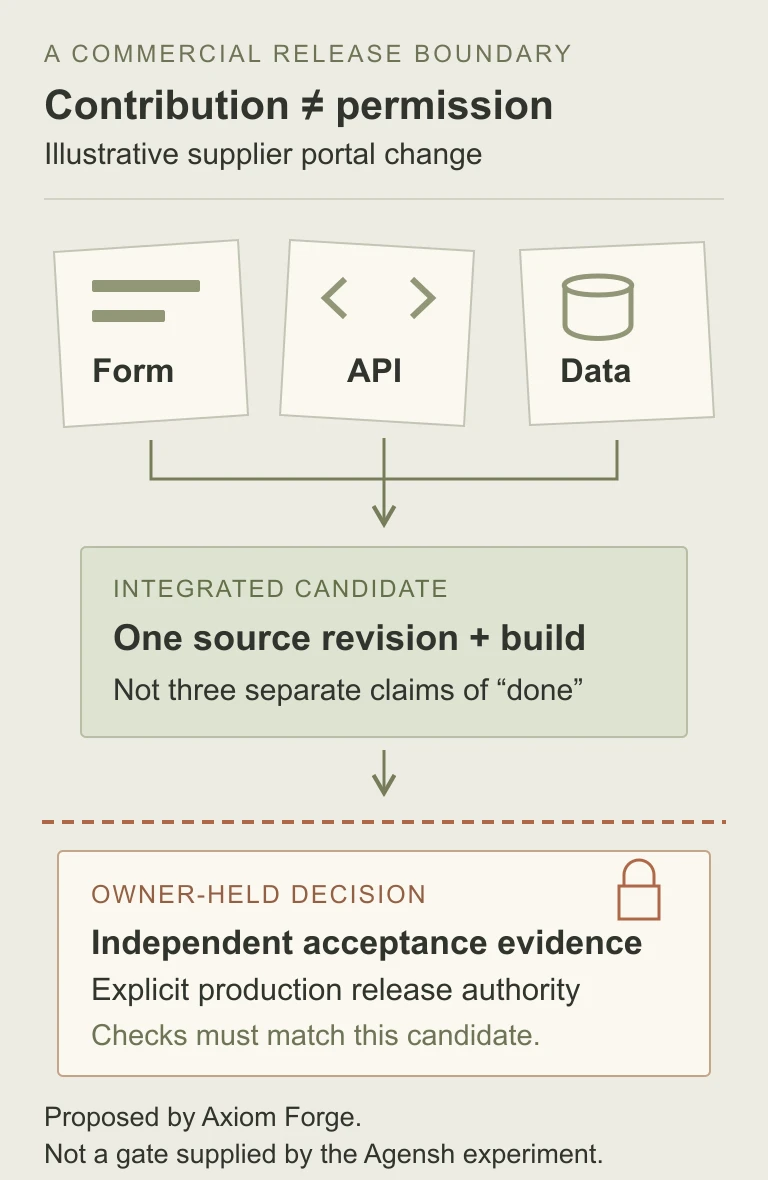
Request one integrated candidate identified by its source revision and build. Review the complete business journey, affected permissions, data compatibility and recovery route against that candidate. Work that changes afterwards needs a new evidence decision; an earlier successful check does not automatically cover a later merge.
The AI acceptance guide covers task-specific evaluation. This release question is narrower: who can turn combined changes into the version real customers receive?
05 / 06
Translate the headline into a supplier conversation
This comparison separates documented research observations from the additional evidence a buyer would need. It does not turn absence of commercial evidence into a claim that Agensh failed its research goal.
| Research observation | What it supports | Buyer evidence still needed |
|---|---|---|
| Peers organise work | Collaboration can occur without a central task-assigning agent in this harness. | Clear file and interface ownership, collision handling and an accountable integrated delivery. |
| More benchmark tests pass | The measured reconstruction task benefits at the reported scale. | Acceptance of the actual business journey, including relevant failure and recovery behaviour. |
| PRs can merge autonomously | The experiment permits progress without mandatory approval or CI gating. | An explicit merge policy, independent checks and separate production release permission. |
| Runs share a time budget | Results can be compared within the stated elapsed-time conditions. | Total model, infrastructure and review cost for an accepted result, including failed attempts. |
Do not ask a supplier to recreate a 1,024-agent headline merely to prove ambition. Choose a bounded piece of work whose acceptance can be checked without trusting the authors’ summary of their own output.
06 / 06
Buy the accepted change, not the size of the swarm
If an agent-team approach is relevant, propose a limited comparison before wider adoption. Record the starting revision, task, constraints, model and harness versions, access permissions and cost ceiling. Keep the same acceptance criteria for the baseline and the proposed team workflow. Include the effort needed to inspect and repair their outputs.
The record should identify the exact delivered build, accepted and unresolved requirements, elapsed time, total measured spend and review effort. An unfinished result remains unfinished even if it is produced quickly. If the comparison changes model, task scope or acceptance policy at the same time as team size, explain that it no longer isolates the effect of adding agents.
Use an isolated environment with appropriate data and permissions. A research harness is not automatic authorisation to connect production secrets, customer records or deployment tools. Security suitability and licence obligations need their own review for the intended use; this article does not certify either.
For an AI-assisted business workflow or an agent-enabled delivery proposal, start with the outcome you want to accept and the authority you will retain. Share it through the project brief or email hello@axiomforge.am. The strongest proposal will explain how progress becomes a trustworthy release—not just how many workers can start.
Sources and editorial scope
This is Axiom Forge’s procurement and product-delivery guidance, not a guaranteed project plan. The example is illustrative. Sources checked on 26 Oct 2026.
- Microsoft — Agensh repository and release chronology — Primary source for the 24 October 2026 code release, peer-coordination design and MIT-licensed public research code. Read 26 October; not evidence of a managed service or production readiness.
- Zhan et al. — Agensh: Scaling Organizational Intelligence to 1,024 Agents — Primary research, first submitted 22 September 2026. The cited Pandoc figures describe benchmark test-pass rates under stated experimental conditions, not commercial acceptance.
- Microsoft — Agensh reproduction guide — Primary documentation of experimental merge controls and release-versus-historical-run differences. This review did not run the harness or independently reproduce the result.
- MarkTechPost — Agensh release coverage, 24 October 2026 — Dated independent coverage used to establish current discussion, not to verify product capabilities or claim popularity metrics.
- FourWeekMBA — Agensh analysis, 25 October 2026 — Additional dated discussion, not independent reproduction, customer adoption or a source for guaranteed business outcomes.