AI & Automation / Buyer’s guide
Mercury 3 Is Fast. When Does Your Product Feel Faster?
Inception’s October 19 diffusion-model release raises a product question: when does fast generation become a useful answer? Examine streaming, refinement and UX.
The short answer
Mercury 3 is worth evaluating where model generation is a real bottleneck, but tokens per second do not describe the whole user wait. Its ordinary stream emits refined text blocks; optional diffusion mode exposes changing whole-text drafts. Choose the rendering and acceptance behaviour deliberately, then compare time to a useful candidate, quality and completed user tasks under the same conditions. This is a documentary analysis, not our model test.
Discuss your project ↗
Our take
A faster stream helps only if the person can recognise, trust and use what arrives.
In this article
01 / 06
The draft is quick. The editor has already moved on.
Imagine a service-portal editor asking an assistant for a short reply. While it works, the editor adds a missing fact to the request and starts writing their own sentence. A draft arrives quickly—but answers the earlier question and replaces the sentence they just wrote.
Nothing about that experience is fixed by a better tokens-per-second figure. This is an invented product scenario, not an observed failure of Mercury 3. It is a way to ask what ‘fast’ needs to mean when a model sits inside an application.
Inception’s Mercury 3 release gives that question a fresh technical angle: diffusion-based text generation and a documented choice between ordinary streaming and visualising intermediate refinement. The interesting buying decision is not whether an animation looks impressive. It is whether the complete interaction helps someone finish the task with less waiting and rework.
Editorial scope: public-source analysis checked on 23 October 2026. We did not call the API, benchmark the model or run a user study. Performance claims below remain attributed claims, not Axiom Forge results.
02 / 06
An October 19 release, not a launch today
Inception’s dated blog index places the Mercury 3 announcement on 19 October 2026. We are examining a significant release from the past week, not presenting an older model as today’s news.
The announcement describes a scaled diffusion-based language model and reports generation at 1,068 tokens per second on NVIDIA GPUs. That is a vendor-reported throughput figure. It is not a measured response time for your prompt, a service-level agreement or evidence that every workload becomes faster by the same factor.
Where a conventional autoregressive system generates a sequence one token after another, diffusion takes a different refinement approach. The important practical limit is not to infer the API experience from a simplified architecture slogan. Mercury’s documented output modes determine what your application actually receives.
The release attracted a substantial Hacker News discussion. That establishes developer interest, not an independent performance verdict. It also does not establish that a particular product should replace its existing model.
03 / 06
A stream of blocks is not a stream of rewritten drafts
Inception’s streaming documentation makes a useful distinction. The normal stream emits blocks of refined text, rather than a strict one-token-at-a-time sequence. The optional diffusing mode exposes intermediate denoising steps, with each chunk containing the full text as it is refined.
For that optional mode, the documentation shows replacing the displayed text at each step. Appending every intermediate version would turn revisions into repeated content. A familiar streaming endpoint shape is therefore not enough evidence that an existing renderer has the correct behaviour.
Our product recommendation is to start with the simplest mode that helps the task. Ordinary block streaming may be enough for a readable reply. Showing changing intermediate drafts may suit an intentional preview, but it adds cognitive and interaction decisions. A non-streaming final response may still be appropriate for a short output if the full wait is acceptable.
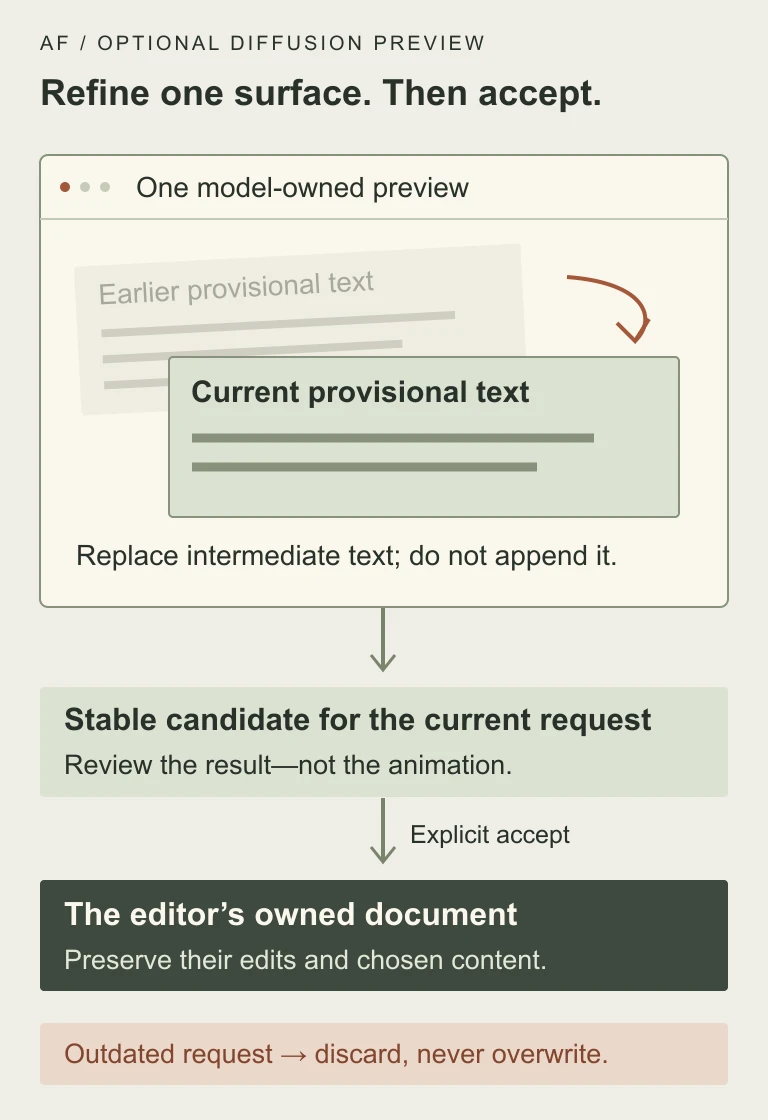
Do not make a person chase a moving sentence while trying to edit it. Keep the provisional preview separate from the text they own, explain when it can be accepted, and define what cancellation means. If the source request changes, an old response should not overwrite the newer context or the person’s own work.
Those are application responsibilities. The model’s stream does not choose which request is current or grant permission to replace an editor’s content.
04 / 06
Measure the useful wait, not only the busy animation
A loading indicator can acknowledge a click immediately while the meaningful answer remains far away. Conversely, a visible draft can arrive early but require so much correction that it does not save the editor time. Keep feedback, a useful candidate and accepted content as separate observations.
For the illustrative reply assistant, define a useful candidate before running a comparison: it answers the current request, respects the required facts and fits the agreed response format. A polished but obsolete reply does not qualify.
| Observation | Question it answers | What not to conclude |
|---|---|---|
| Initial feedback | Does the interface make it clear that the current request started? | A spinner is not a useful answer or model-speed evidence. |
| First useful candidate | When can a person evaluate content that addresses the actual task? | First bytes or first text need not be useful content. |
| Stable candidate | When does the chosen mode expose the answer that will no longer be revised by that request? | An attractive intermediate draft is not necessarily the final result. |
| Accepted task result | Does the editor finish correctly, with acceptable review and correction effort? | High output throughput does not establish time saved or answer quality. |
| Changed or interrupted request | Can the editor change course without stale output replacing current work? | A fast late response is not evidence of a responsive workflow. |
This is a proposed evaluation record, not reported measurements. Keep prompts, context, output constraints, model settings, delivery route and observation method comparable. Inspect slower-tail cases and errors as well as typical successful runs. Include the surrounding retrieval, transport, validation and rendering time; those can remain bottlenecks after generation becomes faster.
Inception’s reasoning-effort documentation lists instant, low, medium and high, with Mercury 3 defaulting to low when the setting is omitted. Record the chosen effort explicitly. A comparison at one setting does not describe the default or prove the same quality/latency trade-off at another.
05 / 06
Keep the model choice smaller than the product promise
The current model/API table lists Mercury 3 as text, with chat completions, tool calling and structured outputs. Do not assume that a model advertised for use in voice products itself accepts raw audio or images. Those inputs require the appropriate supported pipeline.
For the drafting example, an OpenAI-compatible API shape can reduce connection work, but it does not settle prompt behaviour, error handling, cancellation, stream parsing or quality. Keep the first evaluation bounded to one known interaction. Do not expand a short-reply experiment into an autonomous workflow merely because tool calling is listed.
The same official table currently advertises launch pricing at 50% off its regular rates. Treat that as a dated promotion, not a permanent operating assumption. Before contracting, confirm current prices, limits, model/account eligibility, provider route, applicable regional availability, data-handling terms and support commitments. The sources reviewed here do not establish universal country access or a self-hosting entitlement.
Count the cost of accepted work, including retries, review and the surrounding application—not simply a long output multiplied by a discounted token price. A faster candidate that repeatedly ignores the product’s facts may be a worse fit than a slower one.
06 / 06
Start where generation is genuinely on the critical path
Mercury 3 merits a focused look if people are waiting for generated text inside an otherwise responsive application. A short assisted reply or an editor’s suggestion can be a clearer starting point than an entire service process. If the real delay is fetching records, obtaining approval or handling exceptions, changing the generator alone will not remove it.
Our recommendation is a small comparison with a written interaction contract: which input is current, how provisional text appears, when a stable candidate is available, how the person accepts it, and what happens when they edit, cancel or lose the connection. Pair that with a quality sample and a reversible integration decision.
The AI acceptance framework provides the wider evidence boundary; this release analysis adds a specific rendering and responsiveness question. Keep vendor benchmarks, your controlled comparison and actual operating results distinct.
Axiom Forge can discuss AI interfaces as part of its AI and automation service. Send the intended task, current wait, source systems and acceptable review behaviour through the project brief or hello@axiomforge.am. Leave out credentials and private customer content. A scoped evaluation is not a guarantee of faster work or a recommendation to replace your current model without evidence.
Sources and editorial scope
This is Axiom Forge’s procurement and product-delivery guidance, not a guaranteed project plan. The example is illustrative. Sources checked on 23 Oct 2026.
- Inception — Dated release index — Official Mercury3 event date: 19 October 2026, distinct from this analysis date.
- Inception — Introducing Mercury 3 — Diffusion approach and vendor throughput/benchmark claims; not our measurements.
- Inception Docs — Streaming & Diffusion — Refined block streaming versus optional whole-text intermediate refinement; display replacement semantics.
- Inception Docs — Reasoning Efforts — Supported effort settings and Mercury3's low default.
- Inception Docs — Models — Current text/API capabilities and promotional versus regular pricing; verify contract conditions before adoption.
- Hacker News — Mercury 3 discussion — Independent public attention, not capability or reliability evidence.