Mobile Applications / Buyer’s guide
Changing App Development Companies: A Handover Plan
Change your app development company with a dependency inventory, independent build checks and staged responsibility transfer—not just a source-code ZIP.
The short answer
Treat supplier replacement as an operational handover, not a file exchange. Establish who controls the accounts, map the app’s dependencies and prove that the incoming team can build, release and operate the included system. Transfer duties in stages, then retire obsolete access. Moving store ownership or infrastructure is a separate decision and may not be necessary.
Discuss your project ↗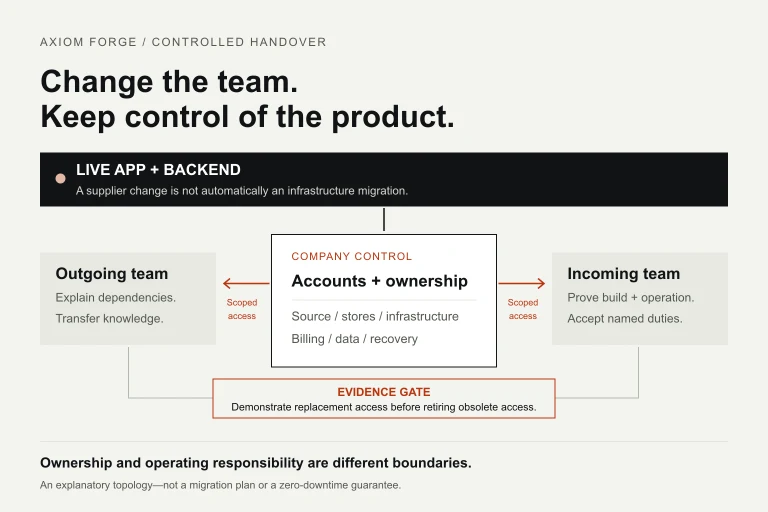
Our take
Keep ownership stable while responsibility changes. The incoming team should demonstrate control of the existing product before a supplier change becomes a redesign or migration.
In this article
01 / 07
Decide which change you actually need
Your current app supplier is no longer the right fit. Perhaps delivery has stalled, the relationship has ended or you need a team with different capabilities. Replacing the supplier can be reasonable without rebuilding the app. Start by separating three changes that are often bundled together.
Delivery responsibility changes who develops and supports the product. Account or asset ownership changes who controls a repository, store listing or service account. Infrastructure migration changes where the system runs. Each needs its own justification, authority and verification. If your company already owns the accounts, a new agency may need scoped access rather than an app-store transfer.
Axiom Forge recommends assessing the existing product before agreeing a replacement architecture. Ask which limitations actually prevent maintenance or improvement, which are merely unfamiliar to the incoming team, and what can stay unchanged. A supplier change alone is not evidence that a rewrite will create business value.
Where both teams can cooperate, a bounded overlap allows the incoming team to observe operation and ask questions. A rapid takeover may be necessary when cooperation is unavailable, but it leaves more unknowns and calls for a narrower initial commitment. If compromised access is suspected, use the security incident procedure and authorised containment; do not preserve dangerous access simply to make the handover convenient.
02 / 07
Build a dependency inventory with owners and evidence
List what the app needs to build, distribute, run and recover—not only the files visible in its repository. Record the legal or account owner, billing owner, current access route, incoming team’s required role and the evidence needed before the outgoing access is removed. Do not put secret values into this inventory.
| Dependency | Control to establish | Incoming team must demonstrate | Handover blocker |
|---|---|---|---|
| Source and assets | Repository, history, build assets, dependencies and permitted use. | Retrieve the complete approved revision, including external assets. | Missing private package, large file or supplier-owned component. |
| Build and signing | Build environment, CI identities and authorised signing route. | Produce an installable candidate through the intended process. | A build works only on an outgoing developer’s laptop. |
| App stores | Company account, app record, release roles and recovery contacts. | Prepare an authorised update without changing app identity accidentally. | Unresolved ownership or transfer eligibility. |
| Backend and scheduled work | Hosting, domains, data stores, queues and background jobs. | Trace the core journey and its asynchronous work in an approved environment. | Unknown automation or an outgoing-only machine identity. |
| External services | Authentication, notifications, payments and service subscriptions. | Verify included integrations using authorised access. | Licence, renewal or account link that does not follow the handover. |
| Data and observability | Data access, dashboards, alerts and recovery procedures. | Read the needed signals and explain the approved recovery path. | No visibility into failure or no established recovery owner. |
| Operating responsibility | Incident contact, deployment authority and support boundaries. | Respond to an agreed rehearsal and identify the next action. | Both teams assume the other owns the incident. |
A missing row is an unknown to resolve, not permission to improvise in production. Shared agency accounts deserve particular attention: the app may depend on a service whose billing or licence also supports other clients. You cannot assume the entire account or the supplier’s internal tools are yours to transfer. Resolve the applicable rights and replacement route with the authorised parties.
03 / 07
Commission a bounded handover from the outgoing team
Request an explanation of the current operating system, not a retrospective sales presentation. The outgoing team should identify the shipped app version, its source revision, backend deployment, configuration sources, known issues and work still in progress. Distinguish production behaviour from an unfinished branch so the incoming team does not mistake partial work for the release baseline.
Ask for build and deployment instructions, an architecture/dependency map, an integration and renewal register, and the procedures used for routine operation and incidents. Record how background jobs, notifications and external callbacks are triggered. Include editable designs and issue history where your agreement permits them, but do not treat a design archive as evidence that the code can run.
Agree the overlap’s deliverables, people, access, cost boundary and stop conditions in writing. Keep one change log and a named deployment authority. Pausing nonessential feature changes can make the baseline easier to understand; required security fixes and incident recovery still need an authorised route. Two suppliers making unrelated production changes during transition creates avoidable ambiguity.
If the former supplier cannot participate, have the incoming team identify what it can verify from available material and what remains unknown. Commission an assessment before accepting a confident maintenance estimate. Missing access, licence restrictions or incomplete source may change the feasible plan; they do not automatically justify recreating every feature.
04 / 07
Let the new team prove capability before taking full duty
Use staged access matched to the work. Initial inspection generally needs less authority than deploying an update. The company’s authorised account owner should approve access; do not share personal owner passwords or place credentials in email, source archives or the handover document.
- Inspect: reconcile the inventory, source revision and live architecture. State missing evidence and access explicitly.
- Reproduce: create a build in a controlled environment using the documented dependencies and authorised signing path. Separate an unsigned build from a store-submittable candidate.
- Trace: follow a representative journey through the app, backend and included jobs. Use synthetic data or an approved test environment rather than unrestricted customer exports.
- Rehearse: demonstrate the intended release and incident process, with owners and recovery limits. A safe rehearsal need not create a production outage.
- Take duty: after agreed evidence is reviewed, document when the incoming team owns the next release and the included support responsibilities.
A completed download of the repository is only the first step. Ask what external packages, assets, CI credentials and service identities the process still requires. If the new team proposes a technical change to reproduce the build, make its purpose and risk visible. Do not combine an ownership handover with an unreviewed platform upgrade.
The evidence gate is operational: can the named team execute the agreed responsibilities without relying on undocumented outgoing access? The release acceptance checklist can then be applied to any actual replacement build. Handover readiness and acceptance of a changed release are related, but they are not the same decision.
05 / 07
If accounts must move, follow each platform’s own boundary
If the app is still held in a supplier-controlled account, an account or app transfer may be necessary. Confirm authority, contractual rights and eligibility before scheduling it. Do not assume a store transfer moves the source code, cloud infrastructure, customer database or every integration.
Apple’s app-transfer documentation says the parties exchange the actual code and build assets separately. It also describes capability-specific preparation. For example, an Apple Pay merchant ID does not transfer with the app, and Sign in with Apple requires user-transfer preparation. The delivery team must inspect the capabilities actually used rather than applying a generic ‘transfer complete’ label to the whole system.
Google Play’s transfer guidance likewise separates the app from integrated-service permissions and linkage. Firebase and other connected services need their own attention. It also distinguishes transferred app data from reports such as historical payout and earnings exports that do not transfer. Preserve the reports your authorised business team needs through an approved process, without giving every contractor access to financial records.
A repository move has another boundary. GitHub documents that associated webhooks, secrets and deploy keys remain with a transferred repository, and collaborator access can remain. Moving the repository is therefore not automatic removal of the outgoing team’s access or machine credentials. Review those dependencies deliberately before retiring access; do not blindly delete a key that an active deployment still uses.
These are platform examples checked on 7 October 2026, not a complete transfer procedure. The authorised owners and qualified delivery team should use the current documentation for the account type, integrations and capabilities involved. Some constraints can require a separate migration plan or specialist review.
06 / 07
Example: source delivery leaves a notification worker behind
Illustrative scenario—not a client case. A membership app lets users view upcoming appointments and receive reminder notifications. The incoming team obtains the source and successfully builds the app. It concludes that the product is ready to support.
The dependency review then finds that reminders are scheduled by a background worker outside the mobile repository. That worker uses an identity controlled by the outgoing supplier. Removing the old access immediately could stop the job, even though the app still opens and the source archive is complete.
The transition record should name the worker, hosting and billing owner, scheduler, relevant service identities, notification integration and the person watching delivery. The incoming team first verifies the approved replacement access and runs a controlled check using a test recipient. It checks both job execution and the receiving outcome; a successful scheduler log alone is not proof that a reminder arrived.
Only after the agreed evidence and authorisation should the team retire the obsolete identity and verify that the scheduled work no longer depends on it. If a company-controlled identity cannot yet be established, that part of the handover remains blocked. A temporary cooperative arrangement may be possible if properly authorised, bounded and acceptable to the company; it is not a permanent substitute for resolved control.
This example does not promise a particular transition time or uninterrupted notifications. It shows why the acceptance of a source package and the transfer of operational duty need different evidence—and why inventorying asynchronous work can change the takeover plan.
07 / 07
Close the transition with a duty record and controlled access retirement
Before the incoming team takes duty, record the current product baseline, inventory, approved roles, demonstrated capabilities, outstanding issues, support coverage and responsible approvers. Name who responds during the overlap and the condition that ends it. ‘Both agencies have access’ does not identify who owns the next incident.
- The incoming team can perform its agreed build, release and operating responsibilities through authorised company-controlled routes.
- The company can identify the owner and renewal responsibility for each material dependency.
- Unresolved dependencies have an explicit owner, impact and next decision; no missing evidence is marked passed.
- The outgoing access-retirement plan covers people and automation, including shared credentials where applicable.
- Changes to secrets are approved, dependent services are updated and verified, and obsolete access is removed once the safe sequence is established.
- Known issues, transition documentation and retained materials have agreed storage and access restrictions.
Proceed when the agreed scope can be operated and the remaining risks are understood by their owners. Extend a bounded overlap when one material dependency still needs verification. Stop and revise the transition when the company lacks rights, control or a credible route to operation. Do not describe a blocked handover as complete just because a new supplier has signed a contract.
Legal rights and third-party licence questions belong in the actual agreement; our source-code ownership guide provides the separate procurement discussion. Ongoing response coverage belongs in your maintenance arrangement. This article is an operational planning guide, not legal advice, a completed audit or a guarantee of zero downtime.
Axiom Forge’s mobile product service includes assessing existing applications as well as commissioning new ones. For a private initial review, send the product’s purpose, platforms, known dependencies and the reason for changing teams through the project brief or email hello@axiomforge.am. Start with a sanitised overview; do not send passwords, signing keys or private customer records in the first message.
Sources and editorial scope
This is Axiom Forge’s procurement and product-delivery guidance, not a guaranteed project plan. The example is illustrative. Sources checked on 7 Oct 2026.
- Apple — Overview of app transfer — Code exchange and capability-specific preparation are distinct from transferring the app record.
- Google Play — Transfer apps to a different developer account — Integrated-service permissions, links and financial-report exceptions require separate attention.
- GitHub — Transferring a repository — Associated automation credentials and collaborator access can remain; a transfer is not access cleanup.