Commerce & Digital · Illustrated edition
The case used to hold six. What does “order again” buy?
When a six-pack becomes an eight-pack, a repeat order can quietly change size. What to ask of your B2B portal, catalogue and warehouse integration.

The short answer
Keep the pack that was actually sold on the accepted order. For a repeat purchase, show the current pack, the resulting number of pieces and the price before anyone commits. If the old packaging is gone, do not silently reinterpret “four cases”.
A reorder is a new purchase, not permission to rewrite the old one.
In this article
01 / 04
Four of what?
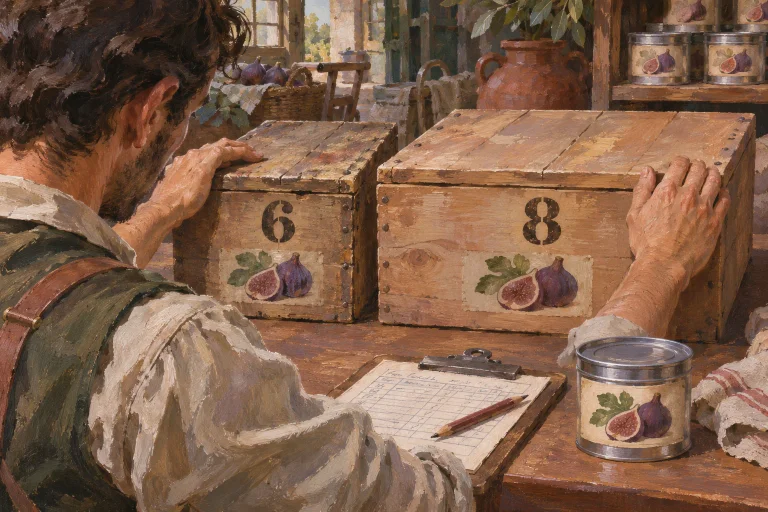
Imagine a café ordering four cases of fig preserves. Six tins fit in each case. By the time the café orders again, the supplier has switched to an eight-tin carton. The product photograph, recipe and café account are unchanged. The familiar button still says “Order again”.
The café may mean “enough for my usual menu”: 24 tins. The warehouse may hear “send four cartons”: 32 tins. Neither is a counting error. The trouble is that the number four travelled between systems without the thing it counted.
02 / 04
Keep the tin. Retire the six-pack.
Ask the supplier to show three things separately: the product the café consumes, the pack the merchant sells and the units the warehouse can pick. They may share a description; they are not interchangeable. If the business uses GS1 identifiers, the GS1 GTIN Management Standard, section 2.8, calls for a new identifier for the affected higher-level packaging when its case count changes. The tin itself need not have changed.
Our recommendation is to preserve the pack identity, pieces per pack, ordered pack count and agreed price on the accepted line. A catalogue update can make the old pack unavailable for new sales without changing an invoice or a pick instruction. If old and new cartons coexist on the shelf, receiving must distinguish them too. “Four cases available” is not meaningful stock information if some hold six and others eight.
03 / 04
Give the buyer the choice the button conceals.

In our example, keeping 24 tins means buying three new cartons. Keeping four cartons means buying 32 tins. Show both the pieces and the price of the proposed purchase; do not assume three new cartons cost what four old ones did. If the customer has a standing order denominated in cases, surface the change to whoever can approve that agreement.
For cafés buying by the piece, a unit-first shop can work well. But it commits operations to splitting cases or clearly displaying whole-pack multiples. A sealed-case distributor can instead sell distinct pack lines and offer a suggested replacement. That is simpler on the picking floor, at the price of asking the buyer to review a discontinued line. If the café previously bought one case of six and eight is now the minimum, there is no exact sealed-case replacement. Let the buyer decline.
04 / 04
Ask for yesterday’s order in tomorrow’s catalogue.
Before accepting a wholesale portal, give the supplier a tiny catalogue and ask them to play both sides of the change. The useful demonstration starts before they edit the pack.
- Place the order. Accept four cases of six at an agreed case price. Leave it unfulfilled.
- Change the catalogue. Introduce an eight-tin pack with a different price. Open the original order and its pick instruction: both should still describe 24 tins and the original pack. If there are no old cartons left, show an exception requiring a decision, not a silent substitution.
- Repeat the purchase. Show the café exactly how many tins and cartons it will receive, and at what total. Cancel the proposal. There should be no new order and no change to the old one.
Bring one real, non-confidential packaging change into the project brief. A team scoping a custom wholesale integration can use it to decide where pack definitions live, who can retire them and how the warehouse treats old stock. That conversation is worth having before anyone approves the design of the reorder button.
Sources and editorial scope
This is Axiom Forge’s procurement and product-delivery guidance, not a guaranteed project plan. The example is illustrative. Sources checked on 14 Nov 2026.
- GS1 GTIN Management Standard — Section 2.8 covers pack/case quantity changes. It does not prescribe a reorder interface or pricing policy.