Enterprise software / Buyer’s guide
The Hold Expired. Then the Payment Arrived.
Specify who gets the last seat when a reservation expires before payment is confirmed. A buyer’s guide to holds, late payments and recovery.
The short answer
A payment confirms what happened to the money, not who owns the seat. Decide which action exclusively allocates the seat, when a hold ends, and who resolves a payment that succeeds too late. Ask two buyers to compete for the last seat in a preview; the result must explain both the ticket and the money.
Discuss your project ↗
Our take
Give the box office two questions it can answer independently: Who can sit here? What happened to this customer’s money?
In this article
01 / 06
Two customers, one seat
Imagine selling the last seat for a workshop. Ana starts checkout while her seat is held. Her bank takes time. When the hold expires, Ben reserves the same seat. Then the payment service reports success for Ana. Which message should each person receive?
This is an illustrative design problem, not a customer incident. A timer alone cannot settle it. If the supplier treats a successful payment as a ticket, Ana could receive a confirmation for a seat already promised to Ben. If it ignores the late payment, the box office loses sight of money it needs to account for.
Start the brief with a rule the operator can defend: the system may not allocate the same seat to two people for one performance. A payment for an expired hold remains a real payment to resolve, even when it can no longer produce that ticket.
02 / 06
What does “held” promise?
A hold is a temporary, exclusive claim on a specified unit of inventory. A place in a queue is not a hold; a basket containing a seat is not necessarily a hold either. If your product offers only a final availability check at checkout, say so before someone leaves to pay.
For fixed seating, name the seat and performance. For a class of interchangeable places, name the capacity pool instead. That distinction changes your recovery options: moving someone to another place may be acceptable for general admission but not for a specifically selected seat.
The server should decide when the claim ends. A browser countdown is a courtesy display, not authority to prolong the hold. Refreshing the page, signing in on another device or returning from the bank should show the current allocation, not silently start a new clock.
03 / 06
Choose the cost of waiting
If slow payment methods matter to your audience, you can keep the seat unavailable while payment is pending. That protects a customer who is waiting legitimately, but makes scarce stock unavailable to others. Set a limit and provide an operator route for payments still unresolved at that limit.
Alternatively, release the seat on schedule and promise an explicit resolution if money arrives later. That is viable only if someone owns the exception queue and can actually make the promised disposition. A third option is to restrict payment methods for the last few seats. You trade payment choice for a simpler allocation promise; delayed event delivery can still occur.
Stripe’s limited-inventory guide describes expiring a Checkout Session. Its fulfillment guide distinguishes checkout completion from later success for delayed payment methods. Those are provider behaviours, not your reservation policy. Ask what the supplier does when the local hold and the payment service disagree.
04 / 06
Never resurrect a seat by replaying a receipt
In our example, Ana’s old hold and Ben’s new one must have different identities. A late event should refer to Ana’s attempt, not merely to the seat number. Recheck ownership before issuing a ticket. If another valid claim now exists, preserve it and open a payment exception.
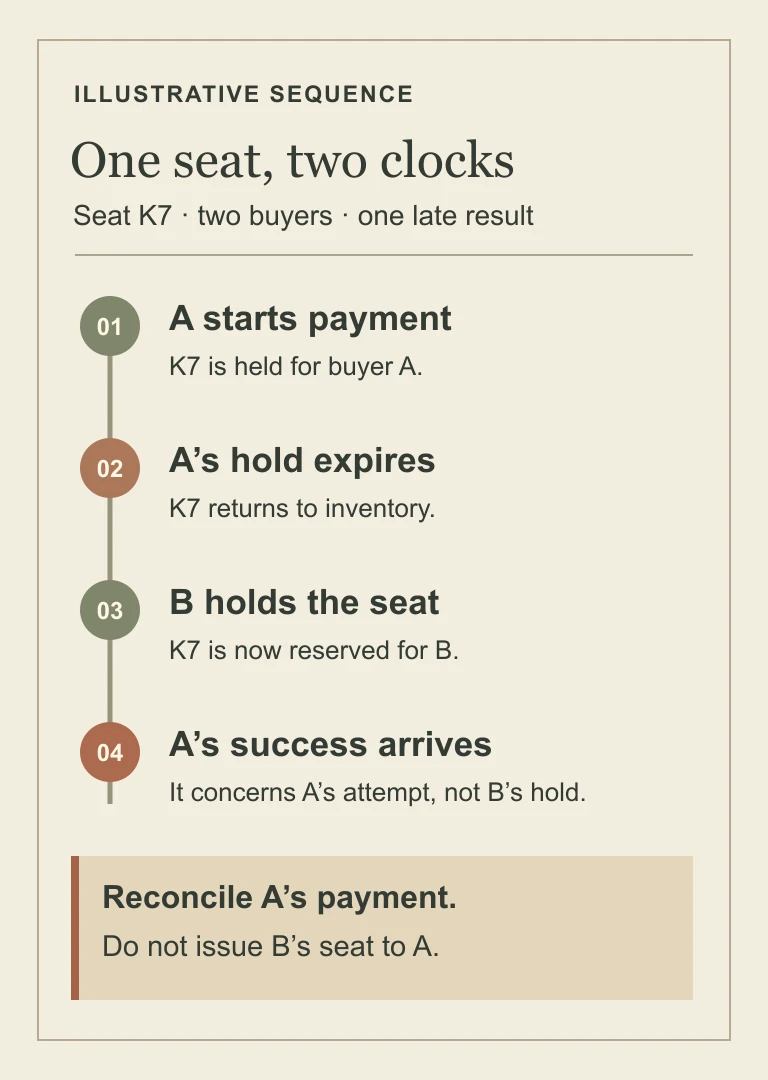
Name the person or team who can resolve the exception. They need the order, hold, payment reference, amount, current seat holder and any earlier action. Depending on the agreed policy they might offer a different seat with consent or initiate a refund. An initiated refund is not a completed refund; show which step remains outstanding.
The customer needs a useful answer before support opens: for example, “We received your payment, but your seat was not confirmed. Your reference is …”. Do not label this case “payment failed” and invite them to pay again.
05 / 06
Run the last-seat rehearsal
Use a preview and simulated payment events. Ask the team to show the inventory view, the two customer views and the operations record for each run. A screenshot of the happy path demonstrates none of the conflicts below.
| Rehearsal | What must remain true |
|---|---|
| Two people request the same seat | Only one acquires a live exclusive hold. The other sees a usable alternative or an honest sold-out state. |
| Payment succeeds at the expiry boundary | A single documented decision determines allocation. Browser and operator screens converge on that result. |
| Old payment arrives after reassignment | The new claim stands. The old payment has an owner and a visible resolution path, not a second ticket. |
| Success is delivered twice | No additional ticket, refund or customer promise is created for the same event. |
| Customer never returns from the bank | Allocation and payment disposition do not depend on the success page loading. |
Ask for the final record, not just the five demonstrations. Every settled payment should point either to the agreed booking or to a traceable exception. Every issued ticket should point back to a valid allocation. Read the result from both directions.
06 / 06
The line worth adding to the brief
“Show us the last available seat, two overlapping attempts, and one late payment. Tell us exactly who may attend, what each customer sees, and who owns the unresolved money.” That single scenario gives a supplier enough detail to price more than a countdown widget.
For related boundaries, see our guides to webhook delivery and booking time zones. If you are commissioning a booking platform, bring your inventory unit, accepted payment methods and late-payment policy to the project brief, or write to hello@axiomforge.am.
Sources and editorial scope
This is Axiom Forge’s procurement and product-delivery guidance, not a guaranteed project plan. The example is illustrative. Sources checked on 6 Nov 2026.
- Stripe — Fulfill orders — Delayed methods and repeat fulfillment calls; the allocation policy is our recommendation.
- Stripe — Manage limited inventory — Checkout Session expiry is one provider mechanism, not proof that an application released a seat.